Monday, January 30, 2006

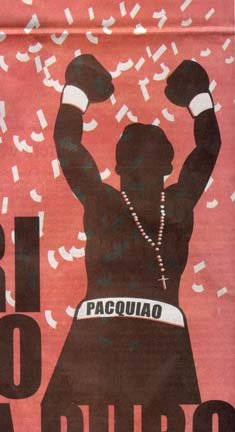
Manny Pacquiao


His victory was our victory. I read in the newspaper that Erik Morales was reported to have said that this fight was first for himself and then for Mexico. This was in contrast to what Manny Pacquiao declared: This fight was dedicated first for the Filipino people and then for himself. That was why his victory was our victory and that was why he was welcomed so warmly by his 'kababayans'.

On the day of his arrival in the Philippines, Cafe Puro ran an ad (part of it is reproduced above). It is the silhouette of Manny. Both arms are raised in victory. But what caught my attention was the rosary around his neck. The said two things about Manny. First, he was Catholic. Only Catholics pray the Rosary. And second, he must be Filipino because only a Filipino Catholic would find it normal to wear the Rosary around his neck.

And then yesterday, I read something in the sports page which made me admire him all the more. It said that during his training in the States, he would go to Mass on Sundays. Wow!

Mabuhay! Manny Pacquiao!

Friday, January 27, 2006

Jim Paredes is Leaving the Country


Yesterday I opened the blog (Writing on Air)of Jim Paredes (APO Hiking Society). I read that he was bringing his family to Australia. And I felt sad. I was surprised why I felt that way. I do not know Jim personally. Neither does he know me personally. So why did I become sad? I reflected for a moment and I realized why.


By leaving the country, Jim had confirmed what I had been feeling for some years already—a great disappointment at what is happening to our country.


Many years ago, we bade good bye to our sister who was leaving for Spain. I will never forget what she told me then, “Kuya, umalis ka na sa Pilipinas. Wala nang pag-asa ang ating bayan.” (Elder brother, leave the Philippies. Our country is hopeless.) I did not share her pessimism then. But not now.


After EDSA 1 I was filled with great hopes for the country. But I was disappointed. I felt that we wasted the chance that God had given to us. Jim felt the same way: “I was tired and had no enthusiasm for any political activism. I felt a deep let-down then which lasts to this day. It dawned on me that we as a people apparently had not learned anything important even after EDSA1, and were squandering our opportunities for real change.”


After EDSA 2 I was encouraged again. I felt that God was giving us another chance. But we blew it. Jim had this to say: “There was EDSA 2 which kind of gave me second thoughts about leaving. But as things turned out, hope for change was very short-lived.”


“Kuya, umalis ka na sa Pilipinas. Wala nang pag-asa ang ating bayan.” My two other siblings have left the country since then. One to Australia (where Jim is bringing his family) and the other to the US. I am the only one remaining.

I love my country. I am happy to be Pinoy. But I am so ashamed to admit it: I have also given up hope for the Philippines.

Thursday, January 26, 2006

Fourth Sunday in Ordinary Time (Year B)

On the sabbath Jesus entered the synagogue and taught (Mk 1:21-28)


Jesus entered the synagogue.

The Jews had only one temple, the temple in Jerusalem. Only there can sacrifices be offered. But they also had houses of prayer, the synagogue.

Elders were in charge of their administration. They were called rulers of the synagogue.

Every Saturday all male Jews gather in the synagogue. There they chant psalms and read passages from the Scripture. Sermons were also delivered. Any competent male could be invited to do this. It was in these instances that Jesus was able to preach in the synagogues.

He taught them as one having authority and not as the scribes.

Scribes were men devoted to the study of the Law. They were addressed as "rabbi". They were not priests, but were held in high esteem. They were represented in the Sanhedrin, the highest governing religious body of the Jews. Many of them belonged to the party of the Pharisees. They drew out rules governing many details of daily life called traditions.

Rabbis stayed mostly in Jerusalem and had disciples to whom they imparted the Law and traditions. It was because of this that Jesus was called a rabbi.

Scribes only repeat, interpret and give the opinion of others. But Jesus teaches on his own authority. He says: "You have heard that it was said, "an eye for an eye; a tooth for a tooth. But I tell you this do not oppose evil for evil."

The fact that the evil spirits obey him is another sign of his authority.

In their synagogue was a man with an unclean spirit

Diabolical possession is a fact, although it is true that in Jesus' time many forms of sickness were associated with diabolical possession. Epilepsy was among them.

I know who you are – the Holy One of God!

Holiness is a divine attribute. The evil spirits recognize the divinity fo Jesus.

Quiet!

Why does Jesus forbid the evil spirits from revealing who he really was? The Jews had a wrong idea of the Messiah. They expected the Messiah to be a military leader and ruler like David. But Jesus was not that kind of Messiah and so he did not want to be identified as Messiah.

REFLECTION: THE SYNAGOGUE

We too have houses of prayer, our churches and our chapels. How do we treat our churches and chapels? Are they playgrounds for children? Are they marketplaces? Are they meeting places for lovers? Are they places for rest and sleep? Are they places for gossip?

Are they not sacred spaces dedicated and set aside for God to be with his children?

Monday, January 16, 2006

Third Sunday in Ordinary Time (Year B)

THE PROCLAMATION OF THE KINGDOM
Mark 1:14-20


Jesus came to Galilee proclaiming the gospel of God.
It is the message coming from God which Jesus Christ brings. It is the message of salvation and it is this - it is God's intention to bring his Kingdom among us immediately.

This is the time of fulfilment.
Immediately after the fall, God made a promise to save mankind. And throughout the centuries, God worked toward the fulfillment of that promise. He, therefore, chose Abraham, then Jacob, and from him was born the Jewish people. And from the Jewish people came Jesus Christ, the promised One. And with Jesus the promse of so many centuries past was at last being fulfilled.

The Kingdom of God is at hand.
The good news is that finally the kingdom of god has been brought to this world. The Kingdom of God is not found in a certain place, as the Kingdom of Jordan is found in a certain place. The kingdom of God is found in the hearts of men because wherever God reigns, the Kingdom of god is there.

Repent, and believe in the gospel.
Or change your ways and believe in the good news. For God to reign in the hearts of men, two things must be done.

First, man must repent. Repentance means coming to one's senses. It involves a change of mind so that one deliberately turns away from sin in his heart in order to turn to God. This will in turn lead him to a change in behavior.

Second, there is need to accept the message of Jesus Christ, and ultimately, to accept Jesus Christ himself. Accepting Jesus means accepting him for who he is - God become man to offer us salvation. Accepting him means accepting what he offers us - forgiveness. Accepting him means accepting the new life he gives as a gift - son / daughter of God.

Monday, January 09, 2006

Sto Nino - January 8, 2006

The discovery of the Philippines is linked to Spain's glorious chain of conquests.

On September 20, 1519, a fleet of five galleons commanded by Portuguese Navigator Ferdinand Magellan at the service of the king and queen of Spain set sailed from San Lucar de Barrameda to search for the Spice Islands. They did not find the spice island; instead they landed in Limasawa, a small island south of Leyte in the central part of the Philippines. Magellan took possession of the islands and named it after King Philip of Spain.

Magellan's expedition headed for Cebu and found the island very hospitable. He made Cebu the base of his exploration, Christianization and conquests. King Humabon and Queen Juana of Cebu gave him a warm reception and embraced Christianity as well. As gratitude to his hospitality, Magellan agreed to fight with king Humabon who was at war with the neigboring tribe, Mactan. Unfortunately, Magellan was killed in the battle. His men returned to Spain, and that same expedition has set the record to be the first to circumnavigate the earth.

Spain sent another expedition to the Far East Region. An Augustinian priest, named Andres Urdaneta, a world-known cosmographer who lived inside the monastic walls of the Augustinian monastery in Mexico was summoned to lead the expedition. On November 21, a memorable expedition left Mexico for the Philippines and arrived in Cebu on April 27, 1565.

DISCOVERY OF THE IMAGE OF THE SANTO NINO

Because of Cebuanos suspicion that their return is bringing retribution to Magellan's death, another battle broke out. But heavy artilleries and huge cannons forced the natives to flee to the mountain leaving behind their villages burnt to the ground. As Spanish soldiers inspected the burnt village, one soldier found an image of the Child Jesus under the pile of ashes unscathed inside the wooden box.

Please refer to this website concerning the celebration of the Sto. Nino in Cebu > http://www.sinulog.ph/

Tuesday, January 03, 2006

Three Kings


A boy was asked who were the Three Kings. Without hesitation he answered: Chow King, Tapa King and Burger King. If you asked anyone from Marinduque, without hesitation, he would answer: Melchor, Gaspar and Baltazar. You shouldn't be surprised because they have three small islands there named after the Three Kings.

EPIPHANY

The solemnity today, however, is not called the Solemnity of the Three Kings but the Solemnity of the Epiphany. What is being celebrated today is not the Three Kings but the manifestation of the King of Kings to the Three Kings. For manifestation or revelation is the meaning of the Greek word, epiphany.

JESUS IS SAVIOR OF ALL

This solemnity is important because it tells us that Jesus is the Savior of all. He is not just the Savior of the Jews. He is also the Savior of the Gentiles. He is not just the Savior of ignorant and poor people, like the shepherds. He is also the Savior of learned and well-to-do men, like the three Magi-Kings. Jesus is the Savior of all because all of us are sinners who can not save ourselves.

SEEKING JESUS

The three Magi-Kings left the comfort and security of their homes and country in search of Jesus. "Where is the new-born King of the Jews? We saw his start at its rising and have come to do him homage."

We too need to set out on a journey in search of Jesus in our lives. And we need to do so with the same urgency and desire as the magi-kings.

And as the song goes, we want to look for Jesus in order to see him more clearly, to love him more dearly and to follow him more nearly.

WHERE IS JESUS?

Where do we look for Jesus? Where did the Three Magi-Kings find Jesus? In a stable. Lying in a manger. If we look at the Belen (creche) we are struck first of all by the silence. We get an idea of the silence of that first Christmas night in the most popular Christmas carol is Silent Night, Holy Night.

Why is there silence? The clue is found by looking at all the characters. All of them are looking at Jesus with reverence. All of them give us the impression that they are all in prayer.

Where then do we find Jesus? In prayer.

Saturday, December 31, 2005

January 1


January 1, 2006. It's New Year according to the civil western calendar. But is this the reason why Catholics go to Mass? Is it to thank God for the year that was and to ask for his blessing for the year that is to be?

No.

January 1 is the solemnity of Mary, Mother of God. This solemnity is a reiteration of what took place on Christmas. It asserts the fact that the baby who was born in a stable is not only a man. He is also God.

No. She did not give the divinity to Jesus. She is only human. You can not give what you do not have. She can only give to Jesus her humanity.

How then can she be Mother of God? (We have to make use of philsophy here.)

Mothers do not carry human natures in their womb. What they carry in their womb are persons.

Mary did not carry in her womb a human nature. She carried a person. And this person is the Second Person of the Blessed Trinity. In St John's language, the Logos (Word). Hence, in the Angelus we pray: "And the Word was made flesh (human being) and dwelt among us."

It is important to note that the articles of faith about the Blessed Virgin and the celebrations in her honor are always in connection with Jesus Christ. True Marian devotion is Christo-centric.

To conclude, what does our faith tell us about Jesus Christ and Mary?
  • That in Jesus, there is one Person, a divine Person, with two natures, human and divine.
  • That Mary is the mother of God because she gave birth to the person Jesus who is God.

Tuesday, December 27, 2005

The Family


The Holy Family is not celebrated on a Sunday this year. It is celebrated on a weekday (December 30).

Here are some of thoughts about family and family life.

There are about 8 million Overseas Filipino Workers today. The upside of this phenomenon are: it keeps the economy afloat; a strong peso; and money for the family. But the downside is the weakening and even the breaking up of the family. Hence, the situation where one or both of the parents work abroad and the children are left behind under the care of one parent or of a relative should not persist for a long period of time.

My brother who works in the US has made it a priority to get his wife and children with him. He will be able to fulfill this priority by the first quarter of next year. He misses them. But more than that he realizes that his children are growing up and he must be part of their growing up years.

A young man shared with me this sad reality. Whenever his Dad returns from work abroad for vacation, he realizes that he can't carry on a conversation with him. Not because he doesn't want to, but because they do not know enough of each other to have a common topic to talk about.

Even when the child understands why the his parents have to be away, the emotional pain remains. Another young man said that his father is a captain of a ship. He was not there during significant moments in his life. He understands that he can't be present because of the nature of his job. But still, he says, I missed him in those moments.

Being acquainted with the school context, I have seen many instances where students with disciplinary or academic problems also have one or both parents working outside of the country. The correlation can not be ignored. Of course, these same students may still have these problems even with both parents around, but the difference is that the parents are here to deal with the situation in loving and firm manner.

The presence of parents then is important. But mere physical presence is not enough. If a parent is emotionally distant, he or she becomes an absent presence. Many fathers are an absent presence. But there are indications that this is changing as fathers become more involved in the raising of their children. They are no longer just providers. Even TV advertisements are becoming aware of this. An ad about diapers have fathers, not mothers, in it.

No matter how hard parents try, they are bound to fail in some way. They are, after all, imperfect. They can not hope to do it right all the time. But if after having done their best and their children do not turn out the way they hoped for, they shouldn't blame themselves saying, "Where did I go wrong?" Perhaps, they did not do anything wrong. Perhaps, it is their children who finally decided to take that path that is wrong.

Friday, December 23, 2005

Love. Peace. Joy.


What was the Christmas song that Michael Jackson popularized when he was younger? Give Love on Christmas Day. I remember our class singing that song for the Christmas program in school.

What is the most popular Christmas carol? It was first sung in German but has been translated into many languages. It was first sung at midnight Mass of Christmas and was accompanied by a guitar. The carol is Silent Night.

What Christmas carol invited people to rejoice? Joy to the World.

Love. Peace. Joy. They make up the spirit of Christmas.

Love

For God so loved the world that he sent his only Son so that those who believe in him may not perish but have everlasting life.

For parents and those who take care of young people, St. John Bosco said that it is not enough that you love them. They must feel that you love them. And for young people, the spelling of love would be t-i-m-e.

Christmas is an eminently family celebration. Without love that is hear-felt, the noche buena would be merely a sumptuous meal rather than a family feast.

Love has become a cliché. But love can find many expressions within the confines of the home. Opening one’s eyes would reveal endless possibilities. Bringing a pasalubong (gift given upon arriving home) to one’s kid brother or sister says “I love you enough to remember you”.

Peace

Isaiah calls Jesus the Prince of Peace. The angels sang: Glory to God in the highest and peace to his people on earth. Christ Jesus came to reconcile us to one another and to the Father.

Peace is not merely the absence of noise or violence. It is present when there is good will and harmony.

We may need to control our temper. We may need to exercise patience. We may have to keep watch over our tongues. More often than not, we use our tongues to hurt one another. We use our tongues in heated exchanges and quarrels.

Joy

The angel said to the shepherds: “I bring you good news of great joy. Today the Messiah is born for you in Bethlehem.”

Be joyful. Be glad. How? Many times making other people happy makes us happy, too. A small act of kindness for another human being is all it takes. I remember one Christmas day, a mother was boarding a jeepney (mode of public transport in the Philippines), perhaps to bring her three children to their ninongs and ninangs (godparents). She obviously needed help. She boarded the jeepney first and I helped her two children board after her. A small thing. But the smile of gratitude on her face made me feel good. It made me happy.

May the Baby Jesus bless you with love, peace and joy not only for this Christmas, but for always.

Happy Christmas.

Monday, December 19, 2005

Christmas Gift-giving


When I was young, I remember my Mom reminding me to hang a sock (my father’s sock) because Santa would be putting goodies there. In the morning I would run to where the sock hung. It was heavy with an apple, an orange, and chocolates (Pom poms, Baby Ruth, M&M’s, golden coins and candies (Life Savers). It was probably why I love chocolates even today.


Christmas was for me the time when I would receive lots and lots of gifts and goodies. I didn’t know it then but the giving of gifts was a continuation of the gift-giving that happened on that first Christmas. For God so loved the world that he gave us the greatest gift that he could possibly gift—his only Son.

We show our appreciation for the gifts we receive by putting them in a place of honor. A woman mounted an unfinished cross-stitch in the sala. It was her mother’s gift to her as she lay dying of cancer.

There is no other place of honor for Jesus, God’s gift to us, than in our hearts. When St. Dominic Savio resolved that Jesus and Mary will be his best friends, that was another way of saying that he was letting Jesus and Mary into his heart.

The Belen depicts the three kings offering their gifts to the Baby Jesus. The Drummer Boy was concerned about the gift that he would be bringing to the Savior. What gift would we bring to Jesus? Perhaps, more attention. Some watches would chime on the hour, every hour. Perhaps we could use that to stop a few seconds and turn our thoughts to Jesus.

A carol says that Love came down on Christmas day. Let Jesus be born again in our families. And the proof of Jesus’ presence is the love and caring that should be expressed and felt in our families. When you give your gift to your parents and to you brothers and sisters, why not do it while saying: “I love you, Mom.” “I love you, Dad.” “I love you, Louie.” “I love you, Erika.”

Christmas is a time of gift-giving. Another word for gift is ‘present’. While a present might be very appreciated, our presence would surely be more appreciated. But our presence should not be merely ‘being there’. It should above all be a loving presence.

Wednesday, December 14, 2005

Fourth Sunday of Advent (Year B)

THE ANNUNCIATION (Lk 1:26-38)


In the sixth month, the angel Gabriel was sent from God to a town of Galilee called Nazareth
Sixth month. 6th month of Elizabeth’s pregnancy.
Gabriel. He was sent first to Zechariah and now to Mary.

To a virgin betrothed to a man named Joseph, of the house of David.
Virgin. Girl who has reached the age for marriage
Betrothed. Engaged. In the Jewish custom, an engaged couple was already considered married, but they would live together only after a year.
David. Through Joseph, Jesus would be of the house of David. This would fulfill the promise that the Messiah would come from David’s line.

And coming to her, he (Gabriel) said,“Hail, full of grace!”
Hail. Also translated a rejoice. Indeed, there is reason for rejoicing because the promise of the Messiah would finally be fulfilled.
Full of grace. Or Favored One. Mary’s new name is “Favored One”.

But she was greatly troubled.
Mary could not understand why and how she was so favored by God.

Behold, you will conceive in your womb and bear a son, and you shall name him Jesus.
Jesus means Yahweh saves or Yahweh is my salvation.

And behold, Elizabeth, your relative, has also conceived a son in her old age.
The pregnancy of Elizabeth is proof that the message of the angel was true.

Mary said, "Behold, I am the handmaid of the Lord. May it be done to me according to your word."
With humility Mary accepted the invitation of God. She knew that her Son would be God but she probably did not understand that fully. Hence, her acceptance (fiat) was an act of faith.

REFLECTION
Mary carried Jesus in her womb nine months. It is a unique grace and privilege. But to all of us, God can give the grace of carrying Jesus in our hearts, in our minds, in our eyes, in our ears and in our hands.
  • Jesus in my heart. The grace of truly loving Jesus.
  • Jesus in my mind. The grace of not forgetting Jesus.
  • Jesus in my eyes. The grace of getting to know Jesus and of imitating his example.
  • Jesus in my ears. The grace of listening to the teachings of Jesus in order to live them.
  • Jesus in my hands. The grace of serving Jesus, of doing what Jesus wants and of doing all for Jesus.

Monday, December 12, 2005

Christmas in the Philippines: The Star Lantern


I took this article from a newspaper. I do not remember which newspaper and who the author was.

We have many old Christmas symbols. Probably the oldest is the Nativity scene, known by its Spanish name belen, or Bethlelem. This is a tradition that is believed to have originated way back in 1223 when St. Francis celebrated Christmas by depicting the Nativity scene complete with live donkey, sheep and ox. By the 17th century, the custom reached Spain, and a century later it was introduced in Mexico from where it was brought to the Philippines. Originally, the only human figures in the belen were the Holy Couple and the Holy Infant. The Three Kings were added during the Epiphany. Today, even the presence of the Three Kings is questionable for on May 9, 1969, the Vatican announced that 33 saints were being officially removed from the Calendarum Romanum. Among them were the Three Kings and St. Nicholas, the prototype of Santa Claus. Originally, gifts were exchanged on December 6, feast day of Saint Nicholas. The Dutch pronounced his name Sinter Klass and that is how St. Nicholas became Santa Claus.


In the Philippines, Santa Claus became the central figure of the Christmas celebration. Gifts were originally exchanged during the Feast of the Three Kings. This was to commemorate the homage that the wise men from the East paid to the Holy Infant that consisted of three gifts: gold, frankincense and myrrh. Today, gifts are exchanged on Christmas day and they are supposed to be presents, not from the Three Kings, but from Santa Claus.

But the truly indigenous Philippine Christmas symbol is neither the belen nor the Santa Claus. It is the star lantern, and that is a story in itself. The star lantern was the Filipino adaptation of the Mexican luminaria which was basically a clay jar with a star shaped hole. The luminaria was actually a clay lamp. When a candle was placed inside, a star representing that of Bethlehem glowed in the dark. This was placed outside every home as a sign that the Holy Couple who was in search of an inn was perfectly welcomed.

In the Philippines, for very practical reasons, the Mexican clay luminaria was transformed into a star lantern. It is so Filipino that of all the Christmas symbols, it is only the star lantern that has evolved into gigantic Christmas displays. In the Pampanga town of San Fernando, the Christmas lantern is not only gigantic in proportion, but more important is that it represents the collective work of the entire community. Men prepare the wooden frame; Women assess the costs and purchase the materials and children prepare the paper patterns. The only work by professionals is the complicated generator-powered lighting complex that will turn the lantern into a modern kaleidoscopic display. These colossal lanterns are placed in trucks and paraded around the town plaza before the Misa de Gallo. In San Fernando, some lanterns have a thousand live bulbs.

But in the ultimate analysis, it is still the simple star-shaped candle-lit lantern that is the true measure of any Philippine Christmas celebration. In his writings, Jose Rizal depicted a sad Christmas saying, "It was Christmas Eve but the town was sad. Not one paper lantern hung from the windows..." We hope this Christmas will not be that sad.

Saturday, December 10, 2005

The Aguinaldo Masses in the Philippines


AGUINALDO MASSES (PHILIPPINES)
The nine-day (novena) Masses in preparation for Christmas begins on December 16. They are called Aguinaldo Masses or Misa de Gallo. Misa de Gallo is Spanish for Mass of the Rooster. The name is apt because the mass take place at dawn (4:30am is the common time) when roosters begin to crow. Aguinaldo is Spanish for gift. It calls to mind the gift of the magi, but above all Jesus who is the gift of God to his people.

For those who can not rise early, there is an alternative, the Simbang Gabi (Mass at night) which often takes place at 8pm. The Simbang Gabi Masses begin in the evening of December 15.

The liturgical color is white, in honor of the Blessed Virgin. The intention of these Masses is the perseverance of the nation in faith. The Glory to God in the Highest is sung as if in anticipation of Christmas.

DECEMBER 17-24
The liturgical readings are more directly concerned with the immediate preparation for Christmas. The message is the mystery of God’s love. The principal personages are John the Baptist, our Lady and St. Joseph.

Wednesday, December 07, 2005

Immaculate Conception


On Dec. 8, 1854, Pope Pius IX in the Bull "Ineffabilis Deus" proclaimed the dogma of the Immaculate Conception: "The Most Holy Virgin Mary was in the first moment of her conception by the unique gift of grace and privilege of the Almighty god, in view of the merits of Jesus Christ, the Redeemer of mankind, preserved free from all stain of original sin."

Four years later in 1858, as if to confirm the dogma, our Blessed Mother made known herself to St. Bernadette in Lourdes as the Immaculate Conception.

400 years before the dogma was defined, Duns Scotus, a Franciscan Theologian, defended the reasonability of the dogma by saying: "God could do it; he ought to do it; therefore, he did it."

The dogma, while directly about the Blessed Mother, is not only about her. It is a privilege and grace granted her because of her unique vocation of Mother of God. Hence, everything about Mary is because of Jesus.

Sunday, December 04, 2005

3rd Sunday of Advent

A MAN NAMED JOHN WAS SENT FROM GOD
(Jn 1:6-8, 19-28)


A man named John was sent from God.
John means "God has given grace". God gave a great grace to Zechariah and Elizabeth, John.

He came to testify to the light.
John would bring others to believe in Jesus. The first two disciples of Jesus were John's disciples. John would say: "Look, there is the Lamb of God!"

He (John) was not the light.
True, yet according to Jesus, John was a burning and shining lamp.

When the Jews from Jerusalem sent priests and Levites to him to ask him, “Who are you?”
The Jews here refer to the Jewish religious leaders hostile to Jesus.

He (John) admitted and did not deny it, but admitted, “I am not the Christ.”
The Hebrew for Christ is messiah. He is the expected Savior. Hence, Jesus Christ means "Jesus the Savior".

So they asked him, “What are you then? Are you Elijah?”
Because of the prophet Malachi, the Jews believed that Elijah would come back and prepare the Messiah's coming. They identified John the Baptists as Elijah because his clothing and his character was similar to Elijah's.

“Are you the Prophet?”
Based on Deuteronomy, the Jews also expected the Messiah to be another Moses. And Moses was considered to be THE prophet. Hence, the Messiah was to be the Prophet who woul repeat on a greater scale the wonders of the exodus.

He (John) said: “I am the voice of one crying out in the desert, ‘make straight the way of the Lord."
The Jews were exiled in Babylon. The prophet tells the people that as in the time of the Exodus when he led his people from Egypt through the desert to the Promised Land, God will now lead them from Babylon through the desert back to the Jerusalem.

John is now the voice preparing God's people for a new Exodus--from slavery to sin to freedom as children of God through the leadership of Jesus, the new Moses.

But there is one among you whom you do not recognize.
The Jews were spiritually blind. Hence, they do not recognize the Messiah.

Whose sandal strap I am not worthy to untie.
Jewish servants do not do this. Only slaves. Hence, the humility of John the Baptist. Later he would say: He (Jesus) must increase. But I must decrease."
MESSAGE
“I am the voice of one crying out in the desert, ‘make straight the way of the Lord.'"

How do we prepare for Christmas? John the Baptist tells us how. Let us put our lives in order. Let us set things aright. Let us turn away from sin and turn to God. Let us return to the right path.

Tuesday, November 29, 2005

2nd Sunday of Advent

PREPARE THE WAY OF THE LORD (Mk 1:1-8)


The beginning of the gospel of Jesus Christ the Son of God.
Gospel is God-spell in old English. It means good news.
Son of God. At the beginning of the Gospel, Jesus is proclaimed Son of God. At the end of the Gospel, Jesus is again proclaimed Son of God by the Centurion as Jesus hung on the Cross.

I am sending my messenger ahead of you.
We are being told that in order to understand the life of Christ, we have to know the Old Testament for Jesus is the fulfillment of the promises made by God in the Old Testament.

John the Baptist appeared in the desert proclaiming a baptism of repentance for the forgiveness of sins.
This baptism is not the sacrament of Baptism. In those days, the use of baptism was in common use in religious groups. For example, the community at Qumran.
John the Baptist thought that the judgment of God was near. In fact, the call to repentance that he was preaching would save people from this judgment.

John was clothed in camel’s hair, with a leather belt around his waist.
John's clothing was similar to that worn by Elijah. Accordding to Jewish belief Elijah would come as the Messiah's precursor. John, therefore, is being presented as Elijah and Jesus as the promised Messiah.

One mightier than I is coming after me.
Some of the first disciples of Jesus were disciples of John the Baptist. This passage was addressed to those disciples of John the Baptist who refuse to accept Jesus as the Messiah.

PREPARING THE WAY OF THE LORD: THE PROCESS OF CONVERSION

1. Awareness of sin. "I have sinned."

2. Taking responsibility for sin. "It is my fault."

3. Confession of sin. The Gospel states: " People of the whole Judean countryside and all the inhabitants of Jerusalem were going out to him and were being baptized by him in the Jordan River as they acknowledged their sins."

4. Giving and receiving forgiveness. "Your sins are forgiven you."

5. Change in the mind that shows itself in change in behavior. "From now on avoid this sin."

Sunday, November 27, 2005

Peace on Earth

PEACE ON EARTH TO MEN OF GOOD WILL

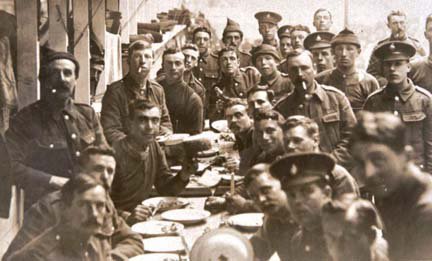
Alfred Anderson died last November 21, 2005. He was 109 years old and at the time the oldest man in Scotland. But that is not all. He was also the last surviving soldier who experienced the spontaneous Christmas truce of World War I. That was December 25, 1914.

"I remember the silence, the eerie sound of silence," said Ander-son. "All I'd heard for two months in the trenches was the hissing, cracking and whining of bullets in flight, machine-gun fire and distant German voices. But there was a dead silence that morning, right across the land as far as you could see. We shouted 'Merry Christmas,' even though nobody felt merry.”

British and German troops cautiously emerged from the trenches that Christmas Day in 1914. The enemies swapped cigarettes and tunic buttons, sang carols and even played soccer amid the mud, barbed wire and shell-holes of no man's land.

Why did this happen? Because the message of Christmas is peace. Christ is called the Prince of Peace. And on that first Christmas night, the choirs of angels sang: “Glory to God in the highest. And peace to his people on earth.”

What do we mean by peace? At home, is there peace if people shout at each other and hurt each other? In school, is there peace, if there is someone you avoid? In other words, there is peace when there is a good relationship.

Make your Christmas a happy one by establishing peace. First make peace with God by making a good confession. Second, make peace with people at home, in your community and in your workplace. Third, if you are already at peace with everyone, then become a channel of peace between enemies. Become an agent of reconciliation.

Sunday, November 20, 2005

First Sunday of Advent

BE WATCHFUL! BE ALERT! (Mk 13:33-37)


Happy New Year!

Yes, it's only November 27. And yes, it's also new year. The First Sunday of Advent marks the beginning of the Liturgical Year in the Catholic Church.

Liturgical Year
The two high points of the Liturgical Year is Christmas (Birth of the Redeemer) and Easter (Resurrection of the Savior). They are so important that the are preceded by a period of preparation and followed by a period of continuing celebration.

Christmas is preceded by Advent and followed by the Christmas season. Easter is preceded by Lent and followed by the Easter Season..

Violet
The color for Advent and Lent is violet. However, the spirit of lent is penitential while that of Advent is joyful.

Gloria
During Advent and Lent, the Gloria (Glory to God in the Highest) is neither sung nor recited. The Gloria is reserved for Christmas when the angels sang it for the first time. However, in the Philippines it is sung during the Simbang Gabi and the Misa de Gallo.

Meaning
Advent means coming. From the first Sunday of Advent till Dec. 16, we are reminded of the Parousia (the second coming of Jesus at the end of time). From Dec. 17 onwards, the focus is the first coming of Jesus when he was born in Bethlehem.

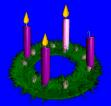
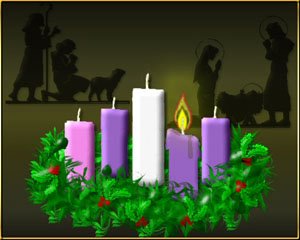
The Advent Wreath
The liturgical symbol for advent is the advent wreath. It serves to focus our attention on the preparation for Christmas.

The wreath (circle) reminds us of eternity. No beginning. No end. God is eternal. His love for us is eternal. Someday we shall join God in eternity.

Green is the color of life. God wants life for us and not death. That is why he sent is only Son that those who believe in him may not perish but have everlasting life.

Candles. Christ is the light of the world. There are four candles representing the four Sundays of Advent. Three candles are violet. One candle is pink which stands for the Laetare Sunday, or Sunday of Joy (third Sunday of Advent).

THIS YEAR WILL CHRISTMAS BE A SEASON OF JOY?

Many are saying that Christmas this year will be sad because of the economic difficulties. (I have heard this for many years now.) But they say this year it will really be gloomy. In fact, the Christmas decorations are so sparse.

When they say that it will be a gloomy Christmas, what they mean is that we shall not be able to buy more Christmas decorations. There will less food at noche buena. No new clothes. Cheap gifts.

But Christmas is not about food. It is not about clothes nor decorations nor gifts.

Christmas is about Christ.

For this reason, there is no reason for this season not to be a joyful one. And precisely because of this, I prefer the greeting "Happy Christmas" to "Merry Christmas".
Sunday, November 13, 2005

Christ the King

CHRIST THE KING (Mt 25:31-46)


EXEGESIS

The scene is the Last Judgment at the end of the world. Jesus appears as a glorious King.

In the Jewish judgment stories, gentiles seldom appear. And when they do, it is to be punished. But in this case, gentiles like Jews are to be judged fairly.

In Palestine, goats and sheep are mixed. But at night they are separated because goats need to be kept warn.

Sheep are often used to symbolize christians.

Those who are on the right are welcomed into the kingdom because of works of fraternal charity ( corporal works of mercy).

The ones on the left are condemned--not for any evil they did, but for the good that they did not do. We sin not only when we do wrong, but when we also fail to do good.

REFLECTION

God sees you. St. John Bosco used to put these words on poster for his boys to see. Why? To keep them from sinning.

We can never hide from God. We can never keep secrets from God. Criminals may get away with it. Crimes may remain unpunished. But with God those who deserve punishment will be punished.

But as God sses us when we do wrong in thought, word or deed, so also God sees us when we do right in thought, word or deed. And these will not go unrewarded.

Sometimes we are misinterpreted or judged unfairly. It is because people can not read into our thoughts. But God can. He will see the good intentions and the good will in our hears. Therefore, God will judge us mercifully.

Wednesday, November 09, 2005

33rd Sunday in Ordinary Time

THE PARABLE OF THE TALENTS (Mt 25:14-30)


EXEGESIS

A man going on a journey....
The ascension of Jesus Christ into heaven.

...called in his servants and entrusted his possessions to them. To one he gave five talents; to another, two; to a third, one....
Talent may be: (a) a measure of weight, (b) a coin worth 30 kg of precious metal, (c) 6,000 denarii, and (d) in this case, abilities given by God to each one of us.

After a long timethe master of those servants came back ....
Delay in the second coming of Jesus (pariousia)

...and settled accounts with them.
Last judgment

See, I have made five more.
Did he make converts for the church?

Come, share your master's joy.
The reward is an intimate association with the Lord. This is reserved for those who have used their talents for the Kingdom.

...so out of fear I went off and buried your talent in the ground.
This was a common practice in Palestine. Cf the Parable of the Buried Treasure

And throw this useless servant into the darkness outside, where there will be wailing and grinding of teeth.
Hell is for those who have not used their talents for the kingdom.

REFLECTION

What are the talents or gifts do I have which I can offer at the service of the Kingdom? (I use Howard Gardner's Theory of Multiple Intelligences as framework.)
  • Am I good with words (Linguistic intelligence or"word smart")?
  • Am I good with numbers and with reasonning (Logical-mathematical intelligence or "number/reasoning smart")?
  • Am I good in the creative use of space (Spatial intelligence or "picture smart")?
  • Am I good in the use of my body (Bodily-Kinesthetic intelligence or "body smart")?
  • Am I good in music (Musical intelligence or "music smart")?
  • Am I good at relating with others (Interpersonal intelligence or "people smart")?
  • Am I good at getting in touch with my inner self (Intrapersonal intelligence or "self smart")?
  • Do I flourish in the midst of nature (Naturalist intelligence or "nature smart")?
All of us have these intelligences. Although we may not possess any of them at the level of a genius, Howard Gardner affirms that with effort and with the guidance of a good teacher, we can develop them to a satisfactory level.

Consequently, no one can truthfully say that he is good for nothing and that he has nothing to offer for the kingdom and for his fellowmen.