Tuesday, August 26, 2014

22ND SUNDAY IN ORDINARY TIME (A)


Whoever wishes to come after me must deny himself, take up his cross, and follow me
Mt 16:21-27

Click to go to << 22nd Sunday in Ordinary Time (A) 2011 >>


Today’s Gospel is divided into two parts: (1) Jesus talks about his suffering and death. Peter reacts negatively to this proclamation. That earns Peter the rebuke of “get behind me, Satan”; and (2) Jesus faces his disciples and tells them that the way of the Cross is not only for him but for those who wish to follow him.

Jesus began to show his disciples that he must go to Jerusalem and suffer greatly from the elders, the chief priests, and the scribes, and be killed and on the third day be raised.

Take note that Jesus said he MUST go, suffer, be put to death and then be raised. That was part of his Father’s plan and so he had to do his part. Jesus was always obedient to the Father’s will. After his encounter with the Samaritan woman at the well, he told his disciples that his bread was to do the will of the Father who sent him. At his agony at the garden of Gethsemane, he prayed that if it were possible let the cup of suffering be taken away from him. But he ended his plea with the words, “Yet not my will but yours be done.” Jesus courageously met the gruesome death of the cross. That was why on the cross, he was able to tell his Father: “Consummatum est.” It is finished. Mission accomplished!

But let us not forget the complete statement of Jesus. He did not only say that he must go to Jerusalem to suffer and die. He said that after dying on the cross, he would be raised on the third day. The story of Jesus was not a tragedy. His story does not end in death. It ends with his resurrection AND ascension into heaven. That’s why he said he would be RAISED—raised from the death and raised up into heaven.

The story of Jesus ended in victory. And that is how God wants our own personal story to end. He doesn’t want our story to end in the tomb. He doesn’t want our death to be the end of our existence. There is an after-life. There is life beyond the grave. In fact, heaven is waiting for us for heaven is the place where we belong. What Jesus told his disciples, he also tells us. “In my Father’s house there are many mansions. If that were not so, would have I told you that I am going there to prepare a place for you?” (Jn 14:2)

There are two other teachings for us in this statement of Jesus.

To gain the glory of his resurrection and ascension, Jesus had to suffer and die. To arrive at Easter Sunday and Ascension Day, he had to go through Good Friday. The same rule applies to us. This rule is behind the quotations: “No pain; no gain. Pag may tiyaga; may nilaga.” This rule is behind the secret formula of deferred gratification. You pass the board exams because you had to spend time to review. And review entailed self-discipline on your part.

Filipino archer Earl Benjamin Yap bagged the gold medal in the 15th Asian Archery Championships held in China on Monday. The first time ever for the Philippines. What was his secret? Not only talent but also the discipline of practice, practice, practice.

Raquel Choa was born into poverty and was forced to sell candles and sampaguita on the streets as a child. At 12 years old she was brought by her grandmother here (Laguna) from Cebu to work as a kasambahay. But she’s no longer here in Laguna. She’s now in Cebu with her husband and 8 children. She has become rich selling Ralfe Gourmet supplying chocolates to various high-end local hotels, resorts and airports throughout the country. During the interview with Karen Davila, she asked Raquel why she was crying. Her answer: “Hindi ko kasi aakalain na malalampasan ko ang buhay na mahirap." Her secret? Hard work.

There is a second teaching that we may find comforting. God the Father did not leave Jesus dead. He is so powerful that he raised him from the dead and seated him at his right hand. Yes, God is so powerful that he can write straight with crooked lines. God can bring good out of evil. No evil that men can do can ever frustrate the designs of God. Therefore, if we but entrust ourselves into the hands of this powerful but tender God, is there no reason why we should not be able to sleep peacefully at night? Jesus assures us: “Are not two sparrows sold for a small coin? Yet not one of them falls to the ground without your Father’s knowledge. Even all the hairs of your head are counted. So do not be afraid; you are worth more than many sparrows.” St. Teresa of Avila believed this in her heart. That’s why she was able to give this advice: “Let nothing perturb you.”


Today’s Gospel reading contains many lessons for us. There are three teachings which we can bring home with us. (1) Death is not the end of our existence. Heaven is waiting for us in the after-life. (2) Easter Sunday and Ascension Day are reached by passing through Good Friday. That is also the rule of life. Kung may tiyaga; may nilaga. And (3) Because we have a powerful and tender God, let nothing perturb you.

Tuesday, August 19, 2014

21ST SUNDAY IN ORDINARY TIME (A)


I will give you the keys to the kingdom of heaven. Whatever you bind on earth shall be bound in heaven; and whatever you loose on earth shall be loosed in heaven.
Mt 16:13-20


Click to go to << 21st Sunday in Ordinary Time (A) 2008 >>

Today’s gospel reading may be divided into three acts or scenes: (a) Jesus asked his disciples who people think he is; (b) Jesus asked his disciples who they think he is. Peter answers in the name of the disciples; and (c) Jesus makes a solemn pronouncement to Peter.

The solemn pronouncement made by Jesus to Peter is of great importance because it establishes the primacy of Peter and his successors. It is on this text that the position of Pope Francis and his predecessors stands.
We must consider the fact that the Gospel of St. Matthew was written for the Jewish Christians living in Galilee and Syria. The purpose of the Evangelist was to strengthen their faith because they were starting to have doubts. They were also being persecuted and so the Evangelist wanted to encourage them to be strong. How does he do this? By recalling the confession of faith that Peter had made in Caesarea Philippi: “You are the Christ, the Son of the living God.” And then by ratifying that confession of faith when Jesus responded by saying: “Blessed are you, Simon son of Jonah. For flesh and blood has not revealed this to you, but my heavenly Father.”

Now we shall focus our attention on the words of Jesus. These are the three statements: (a) Blessed are you, Simon son of Jonah; (b) You are Rock and on this rock I will be build my church; and (c) I will give you the keys of the Kingdom of Heaven.

Blessed are you, Simon son of John. Jesus tells Peter that he is blessed because God had given him the gift of faith to believe that Jesus was the Son of God. Now not everyone has been given this gift of faith. Not everyone accepts Jesus as Son of God. The Muslims, for example, accept Jesus as a prophet but not as Son of God. We should, therefore, be thankful for the gift of faith. We should value this gift. It would not be right for us to say that being a Catholic and being born again or being INC are the same thing. No. It is not the same thing. How can we say that? Because they do not believe in all the things that we believe in.

You are Rock and on this rock, I will build my church. The original name of Peter was Simon. After that confession of faith, Jesus changed his name to Cephas. Now Jesus did not speak Greek or Latin. He, like the other Jews living in the Holy Land, spoke Aramaic. Cephas comes from the Aramaic word “kepa” which means rock. The Greek form would be Petros and Petra. Petros is Peter and Petra is rock. When a person is given a new name in the Bible, it means that he is also being given a mission. His mission would be to be a witness to Jesus and on his testimony Christians can find a strong foundation for their faith. Pope Francis will come to the Philippines in January. He will, of course, comfort the victims of Yolanda. But he comes as a pastor. That is why his visit is called an apostolic visit. And the purpose of any visit of the Pope is to strengthen the faith of the Catholics there.

Jesus makes a very important pronouncement. On this rock I will build my church. Jesus will build his church on Peter. He did not say that he will build his church on Felix Manalo who founded the INC. He did not say that he will build his church on Joseph Smith who founded the Mormons. He did not say that he will build his church on Ellen White, one of the founders of the Seventh Day Adventist church. Jesus said that it was on Peter on which he will build his church.

Finally, Jesus gave to Peter the power of the keys. “I will give you the keys to the kingdom of heaven. Whatever you bind on earth shall be bound in heaven; and whatever you loose on earth shall be loosed in heaven.” The power to bind and to loosen is the power to permit and to forbid. But it also includes the power to reconcile and to forgive. And this power is exercised in a very special way in the Sacrament of Confession. It is not surprising then that the official name of this sacrament is the Sacrament of Reconciliation. In this sacrament the sinner (and all of us are sinners, right?) is reconciled to God through the ministry of the priest. Pope Francis gives importance to this Sacrament. For example, in the last World Youth Day in Rio de Janeiro, Pope Francis heard confessions of the young pilgrims.


We can bring home with us three teachings from the Gospel: (1) We should be happy and grateful because we have been given the gift of the Catholic Faith. (2) We should hold fast to our Catholic faith because our faith rests on the witness of Peter, the rock on which Jesus built his church. And (3) we should value confession because it is the Sacrament through which we sinners are reconciled to God.

Tuesday, August 12, 2014

20TH SUNDAY IN ORDINARY TIME (A)


O woman, great is your faith! Let it be done for you as you wish.
Mt 15:21-28


Click to go to << 20th Sunday in Ordinary Time (A) 2011 >>
Click to go to << 20th Sunday in Ordinary Time (A) 2008 >> 

At that time, Jesus withdrew to the region of Tyre and Sidon.

It is outside the land of Israel. It is pagan territory (non-Jewish) inhabited by Canaanites, long-time enemies of Israel. Tyre and Sidon are found in modern-day Lebanon.

And behold, a Canaanite woman of that district came and called out, “Have pity on me, Lord, Son of David! My daughter is tormented by a demon.”

Only Jews would be familiar with the title, “Son of David”. And they would use it only for the promised Messiah. How did a Canaanite woman who was not a Jew learn about this title? Did she know what it meant? Is this a sign of the beginning of faith in Jesus Christ?

In those days people did not know about germs and viruses. They thought that illness was caused by evil spirits. That’s why she did not say: “My daughter is sick.” Instead she said: “MY daughter is tormented by a demon.” So that her daughter would get well, she would ask Jesus to drive away the demon.

Even today some Filipinos would resort to “tawas” to find out why someone is sick. Even today some Filipinos would explain why someone is sick by saying: “Nakulam.”

But Jesus did not say a word in answer to her.

Why did he not mind the woman? Jesus explains his behavior this way: “I was sent only to the lost sheep of the house of Israel.”

Jesus’ disciples came and asked him, “Send her away, for she keeps calling out after us.”

The woman was making a scene. She was creating a scandal. And the disciples were not comfortable at all the people looking at them.

This woman would not take no for an answer. She wouldn’t give up even if Jesus was not minding her. She was persistent. Why? Because a mother would do everything to make her child get well. 

Maybe St. Matthew included this story in his gospel in order to teach us about perseverance in prayer, about praying and not getting discouraged. Maybe St. Matthew used this story of the Canaanite woman in order to explain this saying of Jesus: "Ask, and it will be given you. Seek, and you will find. Knock, and it will be opened for you. For everyone who asks receives. He who seeks finds. To him who knocks it will be opened.” (Mt 7:7-8)

But the woman came and did Jesus homage, saying, “Lord, help me.”

What does “did him homage” mean? It means to bow. Is this a sign of respect. Or is this already, as I have said, an expression of faith, that Jesus was not an ordinary man but at least, a man of God.

He said in reply, “It is not right to take the food of the children and throw it to the dogs.”

The Jews called pagans “dogs”. It was supposed to be an insult. Did Jesus mean to insult the woman? This would be out of character for Jesus. I would think that if Jesus were texting, he would put a smiley at the end of his text message.

She said, “Please, Lord, for even the dogs eat the scraps that fall from the table of their masters.”

This woman was not only persistent. She was also witty. She used the very words of Jesus to get him to grant her wish for her daughter’s healing.

This reminds me of a conversation between St. Teresa of Avila and Jesus. She was on her way to visit one of the convents which she had established. But the heavy rains had swollen the river. She could not cross it. And that made her angry. Then Jesus appeared to her and said: “That is how I treat my friends.” St. Teresa, who was also a witty woman, retorted: “That explains why you have so few friends!”

Then Jesus said to her in reply, “O woman, great is your faith! Let it be done for you as you wish.” And the woman’s daughter was healed from that hour.

Faith is the key that unlocks the blessings from heaven. Faith makes it possible for us to receive the graces that God wants to give to his children. God’s blessings are like rain that falls from the sky. If we have faith, our hands would be open to catch these blessings. But if our faith were weak, then our hands would be closed and these blessings would slide away from our grasp.

If we have a weak faith, it would not really be a big problem. Faith is gift from God. Because it is a gift, we can ask for it, we can pray for it. And we shall receive sufficient faith. For did not Jesus promise us: Ask and you shall receive.


Today’s gospel teaches us three lessons: (1) Prayer that does not give in to discouragement because it comes from a strong faith; (2) Faith is necessary for us to receive the blessings from heaven; and (3) If our faith is weak, then we can pray for a strong faith because Jesus promised: Ask and you shall receive.

Wednesday, August 06, 2014

19TH SUNDAY IN ORDINARY TIME (A)


At once Jesus spoke to them, “Take courage, it is I; do not be afraid.”
Mt 14:22-33

Click to go to << 19th Sunday in Ordinary Time (A) 2011 >> 
Click to go to << 19th Sunday in Ordinary Time (A) 2008 >>

After he had fed the people, Jesus made the disciples get into a boat and precede him to the other side, while he dismissed the crowds.

In Jn 6 the crowds wanted to make Jesus King by force. Jesus did not want his disciples to get that idea into their heads. So he sent them away.

Parents need to keep watch over their children against bad influence. That usually means bad barkada, bad reading materials and bad videos.

Do something more positive. (1) Get to know the barkada of your children. Provide opportunities for them to visit your home. (2) Form the conscience of your children. Discuss the values and counter-values in the news, TV and movies.

After doing so, he went up on the mountain by himself to pray.

WE usually think of prayer as asking God for this or for that. But prayer is more than that. In this particular episode, we might consider this as a bonding time that Jesus set aside for his Father and himself. We can also turn our prayer time into a time for bonding with God.

Meanwhile the boat, already a few miles offshore, was being tossed about by the waves, for the wind was against it.

Take note that this is not a storm.

During the fourth watch of the night, he came toward them walking on the sea. When the disciples saw him walking on the sea they were terrified. “It is a ghost,” they said, and they cried out in fear.

Jesus was walking toward them because he wanted to get into the boat. Even if he could walk on the water, the distance to the other side was so big that it was more convenient to ride on the boat.

The disciples were naturally frightened. It was still dark. They could not possibly recognize Jesus. You also would be frightened if you saw something moving towards you over the waters.

At once Jesus spoke to them, “Take courage, it is I; do not be afraid.”

Someone counted 365 instances when the words “do not be afraid” were uttered in the Bible. That means for every day of the year God reassures us: “Do not be afraid because I will be with you throughout this day.”

Peter said to him in reply, “Lord, if it is you, command me to come to you on the water.”

This was an act of faith in Jesus. Peter believed that he could also walk on the water if Jesus gave him the permission. And in fact, he was able to walk on the water. The bible says: “Peter got out of the boat and began to walk on the water toward Jesus.”

But something went wrong. He began to be afraid. And he began to sink. Fear meant a weakening of faith. And with a weakening of faith, he lost the power to walk on the water. In fact Jesus scolded Peter: “O you of little faith, why did you doubt?”

Something went wrong. What went wrong? The bible says: “But when he saw how strong the wind was he became frightened.” That meant that he turned his gaze away from Jesus and looked at the wind and waves. As long as we keep our eyes fixed on Jesus, as long as we remain aware of the presence of Jesus, we shall feel confident and unafraid. Once we forget Jesus, we shall be overcome by doubts and fear. But when that happens, we can still cry out with Peter: “Lord, save me!”

Immediately Jesus stretched out his hand and caught Peter.

And as Jesus rescued Peter, so Jesus will rescue us.


Let us bring with us into our daily lives two quotations from today’s Gospel. When things go wrong during the day, let us visualize Jesus telling us: “Take courage, it is I; do not be afraid.” And when fears and self-doubt assail us,  let fix our eyes on Jesus and cry out to him: “Lord, save me!”

Saturday, August 02, 2014

18TH SUNDAY IN ORDINARY TIME (A)


Taking  the five loaves and the two fish, and looking up to heaven, he said the blessing, broke the loaves, and gave them to the disciples, who in turn gave them to the crowds.
Mt 14: 13-21


Tuesday, July 08, 2014

15TH SUNDAY IN ORDINARY TIME (A)


And as he sowed, some seed fell on the path…. Some fell on rocky ground…. Some seed fell among thorns…. 
Mt 13:1-9


Click to go to << 15th Sunday in Ordinary Time (A) 2011 >>


Tuesday, July 01, 2014

14TH SUNDAY IN ORDINARY TIME (A)


My yoke is easy, and my burden light.
Mt 11:25-30

Click to go to << 14th Sunday in Ordinary Time 2011 >>
Click to go to << 14th Sunday in Ordinary Time 2008 >>

Tuesday, June 24, 2014

SOLEMNITY OF ST PETER AND ST PAUL


I will give you the keys to the Kingdom of heaven.
Mt 16:13-19

Click to go to << Solemnity of St. Peter and St. Paul >>

Tuesday, June 17, 2014

CORPUS CHRISTI (A)


And the bread that I will give is my flesh for the life of the world.
Jn 6:51-58

Click to go to << Corpus Christi 2011 >>
Click to go to << Corpus Christi 2008 >>

Tuesday, June 10, 2014

TRINITY SUNDAY (A)


God so loved the world that he gave his only Son, so that everyone who believes in him might not perish but might have eternal life.

Jn 3:16-18

Click to go to << Trinity Sunday (A) 2011 >>
Click to go to << Trinity Sunday (A) 2008 >>

Tuesday, June 03, 2014

PENTECOST (A)


And they were all filled with the holy Spirit and began to speak in different tongues, as the Spirit enabled them to proclaim.
Acts 2:1-11

Click to go to << Pentecost 2011 >>
Click to go to << Pentecost 2008 >>

Tuesday, May 27, 2014

ASCENSION (A)


And behold, I am with you always, until the end of the age.
Mt 28:16-20


Click to go to << Ascension (A) 2011 >>
Click to go to << Ascension (A) 2008 >>

Tuesday, May 20, 2014

6TH SUNDAY OF EASTER (A)


And I will ask the Father, and he will give you another Advocate to be with you always.
Jn 14:15-21

Click here to go to << 6th Sunday of Easter (A) 2011 >> 
Click here to go to << 6th Sunday of Easter (A) 2008 >>

Friday, May 16, 2014

5TH SUNDAY OF EASTER (A)


And if I go and prepare a place for you, I will come back again and take you to myself.
Jn 14:1-12


Click to go to << 5th SUNDAY OF EASTER (A) 2008 >>

Tuesday, May 06, 2014

4TH SUNDAY OF EASTER


The sheep hear his voice, as the shepherd calls his own sheep by name and leads them out.
Jn 10:1-10

Click to go to << 4th SUNDAY OF EASTER (A) 2011 >>
Click to go to << 4th Sunday of Easter (A) 2008 >>

Tuesday, April 29, 2014

3RD SUNDAY OF EASTER (A)


And it happened that, while he was with them at table, he took bread, said the blessing, broke it, and gave it to them. With that their eyes were opened and they recognized him, but he vanished from their sight.
Lk 24:13-35

Click to go to << 3rd Sunday of Easter 2011 >>
Click to go to << 3rd Sunday of Easter 2008 >>

Wednesday, April 23, 2014

2ND SUNDAY OF EASTER (A)


“Unless I see the mark of the nails in his hands and put my finger into the nailmarks and put my hand into his side, I will not believe.”
Jn 20:19-31


Click to go to << 2nd Sunday of Lent - A >>

Tuesday, April 15, 2014

EASTER SUNDAY


Then Simon Peter came, following him, and went into the tomb; he saw the linen cloths lying, and the napkin, which had been on his head, not lying with the linen cloths but rolled up in a place by itself.

John 20:1-9

FROM CATHOLIC MATERS:

EXPLANATION: The accounts of Christ's resurrection on Easter morning as given by the four Evangelists vary in details but agree on the essential points. Some women, the leader amongst them being Mary Magdalene, came to the tomb early on Sunday morning to anoint the dead body with spices, in order to help preserve it. This anointing had been done very hastily on the Friday because of the Sabbath which began at sundown. The tomb was found open and empty. The first thought of the women was that somebody had stolen the corpse. This shows how far resurrection was from their minds. They went in haste to tell the disciples. Peter and John ran to the tomb. Later that day Christ appeared to Mary Magdalene, to ten of the Apostles, to Peter separately (according to St. Paul, 1 Cor. 15: 5), to two disciples on the road to Emmaus (Lk. 24: 13); and, later on, he appeared often to the Apostles and disciples in Galilee, for a period of days.
 
First day of the week: The Sabbath was the last day of the Jewish week, so the first day corresponds to what is now called Sunday.


Mary Magdalene: John mentions only Magdalene by name but the " we don't know " in verse 2 implies there were others with her.


stone had been moved away: The tomb was raised above the ground and its entrance was closed by rolling a large stone, cut for the purpose, across the entrance (see Mk. 16: 3).


they . . . the Lord: This was Magdalene's only possible explanation of the absence of the body.


Peter and the other disciple: Peter and John ran to the tomb. When they found the winding sheet and the cloth that covered the head lying there, they realized that the body had not been stolen or taken away: why should the linen coverings have been removed?


He saw and believed: That Peter had been the first to believe and then John, seems the meaning here, not that John believed in contrast to Peter.


as yet they did not understand: Until this moment they had not understood the scriptures which had foretold his resurrection. In fact neither had they believed Christ's own prophecies of his resurrection---it seemed to be something which could not happen.  

Thursday, April 10, 2014

PALM SUNDAY


A "LECTIO DIVINA" (please click "Lectio Divina") OF THE PASSION NARRATIVE OF PALM SUNDAY BY THE ORDER OF CARMELITES.

Tuesday, March 25, 2014

4TH SUNDAY OF LENT (A)


I am in the world, I am the light of the world.
Jn 9: 1-41

Click to go to << 4th Sunday of Lent (A) 2011 >>
Click to go to << 4th Sunday of Lent (A) 2008 >>

Thursday, March 20, 2014

3RD SUNDAY OF LENT (A)


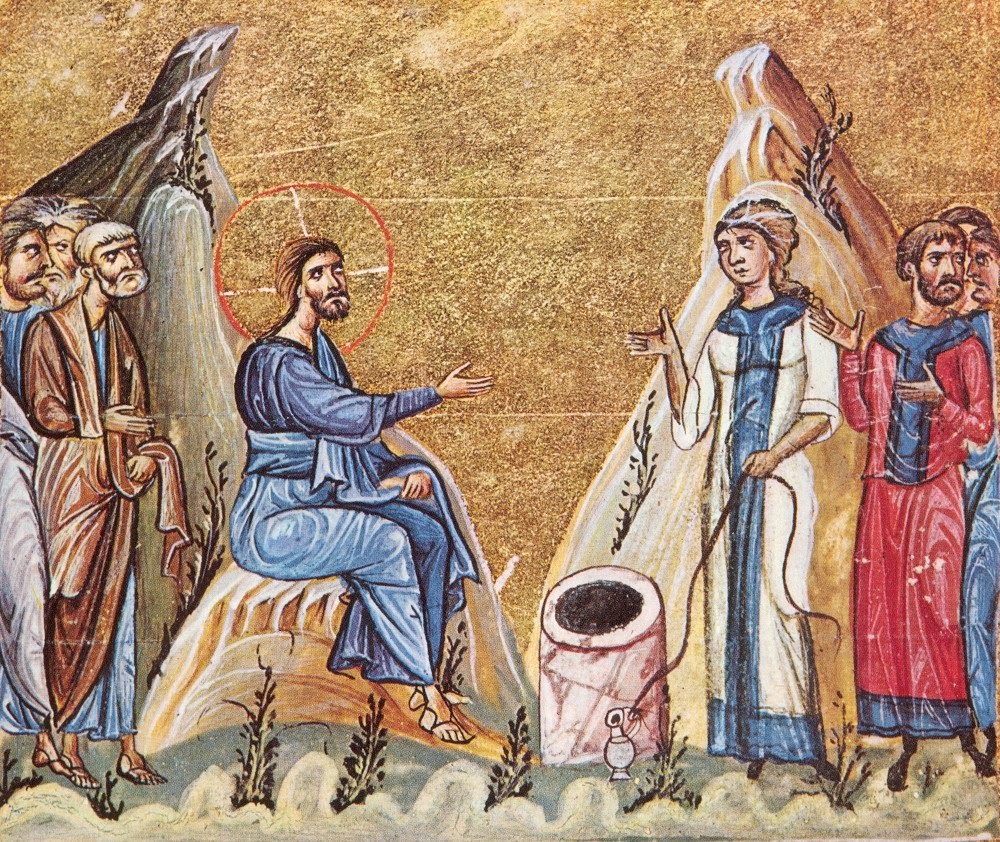
A woman of Samaria came to draw water. Jesus said to her, "Give me a drink."
Jn 4:5-42

Click to go to << 3rd Sunday of Lent (A) 2011 >>
Click to go to << 3rd Sunday of Lent (A) 2008 >> 

Tuesday, March 11, 2014

2ND SUNDAY OF LENT (A)


And he was transfigured before them; his face shone like the sun and his clothes became white as light.
Mt 17: 1-9


Click to go to << 2nd Sunday of Lent (A) 2011 >> 
Click to go to << 2nd Sunday of Lent (A) 2008 >>

Tuesday, March 04, 2014

Tuesday, February 25, 2014

8TH SUNDAY IN ORDINARY TIME (A)


No one can serve two masters. He will either hate one and love the other, or be devoted to one and despise the other. You cannot serve God and mammon. 
Mt 6:23-34

The parallels to these verses in Matthew are spread out in three different chapters of Luke: Mt 6:22-23 =  Luke 11:-35; Mt 6:14 = Luke 16:13;  Mt 6:25-34 = Luke 12:22-31. 

v. 22-23. The lamp of the body is the eye. If your eye is sound, your whole body will be filled with light; but if your eye is bad, your whole body will be in darkness. And if the light in you is darkness, how great will the darkness be.

We have already been reminded that the lamp gives light to all in the house (5:15); similarly, the eye gives light (insight) to the whole body:  whether you are a seeing man or a blind man depends entirely on your  eyes. In what sense is Matthew using this parable? “Sound” is “haplous”, which as we have seen means both single and generous; “not sound” is  “poniros”, and “the evil eye” means “grudging”, “mean”, “stingy”.  If the disciple is generous towards God, he will be full of light (perfect, as his heavenly Father is perfect 5:48). If he is mean, he will be full of darkness  (like the devil). The next saying expounds the other sense of “haplous” =  single or simple. The disciple must keep his eye on one master, not on two.

v. 24. No one can serve two masters. He will either hate one and love the other, or be devoted to one and despise the other. You cannot serve God and mammon.

The man with the eye which is not sound is attempting the impossible—to serve two masters; the man with the sound eye has chosen God.  Mammon is an Aramaic word, meaning “wealth”, “property”. Devotion to God cannot be combined with devotion to mammon, because, as we have seen already, there will be occasions when the former will demand  the sacrifice of the latter (5:29. 30. 40). A choice is therefore necessary between God and mammon; or between faith and anxiety (see following verses).

v. 25. Therefore I tell you, do not worry about your life, what you will eat [or drink], or about your body, what you will wear. Is not life more than food and the body more than clothing?

The disciple who is told not to serve mammon may well reply, “But I must have enough to live and to clothe myself. To this, Jesus replies that God who has made life and the body will certainly look after those things which are less than these - viz. food and clothing.

v. 26. Look at the birds in the sky; they do not sow or reap, they gather nothing into barns, yet your heavenly Father feeds them. Are not you more important than they?

Moreover, he feeds the birds: how much more will he feed men.


And anxiety cannot increase a man's span of life (or stature [margin], “helikia” can mean both). Cf. 5:36 for our inability to control the colr of our hair. These things are in the hands of God.

vv. 28-30. Why are you anxious about clothes? Learn from the way the wild flowers grow. They do not work or spin. But I tell you that not even Solomon in all his splendor was clothed like one of them. If God so clothes the grass of the field, which grows today and is thrown into the oven tomorrow, will he not much more provide for you, O you of little faith?

The same type of argument as that in v. 26 above is used with regard to  anxiety about clothing. God clothes the lilies, even better than man can  clothe himself; the lilies are of less value than man: therefore God will  take care of man's clothing. To think otherwise is to be men of little  faith (“oligopistoi”, a rare word, which Matthew uses four times: here and  8:26, 14:31, 16:8; the only other occurrence of it in the New Testament is  Luke 12:28, the parallel to this passage: did Luke take it from here?).

v. 31. So do not worry and say, ‘What are we to eat?’ or ‘What are we to drink?’ or ‘What are we to wear?

Repeats v.25 in order to round off' the passage - an example of  Matthew's use of inclusio.

v. 32. All these things the pagans seek. Your heavenly Father knows that you need them all.

The Gentiles (who live without faith in God, cf. 5:47) are anxious about  these things. The disciples, on the other hand, are to trust God as the Father who knows all their needs before they ask (cf 6:8).

v. 34. Do not worry about tomorrow; tomorrow will take care of itself. Sufficient for a day is its own evil.

The final futility is to be anxious about tomorrow: tomorrow is completely outside our possible control today (cf. 5:36 and, 6:27). There is a possible set of verbal links common to vv. 33, 34, and vv. 10, 11 in the Lord's Prayer: kingdom, righteousness, tomorrow, this day; kingdom, [God's] will, this day, and tomorrow.


Tuesday, February 18, 2014

7TH SUNDAY IN ORDINARY TIME (A)


So be perfect, just as your heavenly Father is perfect
Mt 5:38-48

v. 38 - You have heard that it was said, 'An eye for an eye and a tooth for a tooth.'

See Ex 21:24; Lv 24:20; Dt 19:21

v. 39 - But I say to you, offer no resistance to one who is evil. When someone strikes you on (your) right cheek, turn the other one to him as well.

The mention of the right cheek implies that the blow is made with the back of the aggressor’s hand. This was a particularly insulting assault and was subject to a specially heavy fine.

v. 40 - If anyone wants to go to law with you over your tunic, hand him your cloak as well.

Tunic (Gr., chiton) is the undergarment while the cloach (Gr., himation) is the outer garment. The former may be demanded as a legal fine or pledge. Cf. Ex 22:25f and Dt 24:13f.

v. 41 - Should anyone press you into service for one mile, go with him for two miles.

The Romans followed the Persian practice of requisitioning privately-owned horses, etc. for public service. The word “press” (Gr., angareuein) is the technical term for such requisitioning. Cf. Mt 27:32 where Simon of Cyrene is compelled to carry the cross of Jesus.
The disciples are not only to be liberal with their possessions – their time is also to be available.

v. 42 - Give to the one who asks of you, and do not turn your back on one who wants to borrow.

They are to give to beggars and to lend to borrowers. They are to have no anxious care for their property in this world. Cf. Heb 10:34.

v. 43 - "You have heard that it was said, 'You shall love your neighbor and hate your enemy.'

The first part is a quotation from Lv 19:18. The second part is not found in the OT. The Jews did limit the interpretation of neighbor to fellow Jews. They may in practice conclude that Gentiles were to be hated. In one of the Dead Sea scrolls we find written: “…(it is the duty of the members of the sect) to love everyone, whom he (God) has elected, and to hate everyone, whom he has rejected….’

v. 44 - But I say to you, love your enemies, and pray for those who persecute you….

The disciples are to be indiscriminate in their love, and love those who hate them, and pay for those who persecute them. It is not enough to be persecuted. They must meet their persecutors with love and prayer.

v. 45 – “…that you may be children of your heavenly Father, for he makes his sun rise on the bad and the good, and causes rain to fall on the just and the unjust.”

The indiscriminate good of the disciples is a reflection of the goodness of their Father.

v. 46 - For if you love those who love you, what recompense will you have? Do not the tax collectors do the same?

To return love for love is another form of an eye for an eye. It does not involve doing anything more that what those who are outside even the old Israel (e.g. tax collectors) do. Therefore it merits no reward.

v. 48 - So be perfect, just as your heavenly Father is perfect.

Compare this with Lv 19:2.

Under the old covenant, holiness had involved separation from those outside Israel; and there is still a sense in which the disciples are to be distinct from the world (salt of the earth and light of the world). But the separation must not take the form of refusal to love.
The perfection of the disciples is a perfect love – this is the final truth about the new righteousness, which exceeds that of the scribes and pharisees. And in fact, this is the fulfillment of the law and the prophets (Mt 5:17).  Cf. Rm 13:9ff.

The law of Jesus is impossible because it puts before us a perfection that is beyond our capability. His law is not a set of detailed set of instructions. It is reducible to one word, “love”.

The law of Jesus is simple and yet demanding and by it the disciples are made entirely dependent on God because only the grace of God can enable us to keep the law of Jesus.

Monday, February 10, 2014

6TH SUNDAY IN ORDINARY TIME (A)


I tell you, unless your righteousness surpasses that of the scribes and Pharisees, you will not enter into the kingdom of heaven
Mt 5:17-37

Click to go to << 6th Sunday in Ordinary Time 2011 >>

Wednesday, February 05, 2014

5TH SUNDAY IN ORDINARY TIME


You are the salt of the earth. You are the light of the world. 
Mt 5:13-16


Click to go to << 5th Sunday in Ordinary Time 2011 >>

Tuesday, January 28, 2014

FEAST OF THE PRESENTATION


When the days were completed for their purification according to the law of Moses, Mary and Joseph took Jesus up to Jerusalem to present him to the Lord.
Lk 2:22-40

Please go to << Sacred Space >>

Tuesday, January 21, 2014

3RD SUNDAY IN ORDINARY TIME (A)


“Repent, for the kingdom of heaven is at hand.”
Mt 4:12-23

Click to go to << 3rd Sunday in Ordinary Time (A) 2008 >>
Click to go to << 3rd Sunday In Ordinary Time (A) 2011 >>

Monday, January 13, 2014

STO. NINO


Click to go to << Sto. Nino 2010 >>
Click << Gospel 2013 >> for Gospel explanation (Gospel for Holy Family and Sto. Nino are the same).

Tuesday, January 07, 2014

BAPTISM OF THE LORD (A)


And a voice came from the heavens, saying, "This is my beloved Son, with whom I am well pleased."
Mt 3:13-17

Click to go to << Baptism of the Lord 2011 >>

Click to go to << Baptism of the Lord 2007 >>

Tuesday, December 31, 2013

EPIPHANY (A)


EPIPHANY
They were overjoyed at seeing the star, and on entering the house they saw the child with Mary his mother. They prostrated themselves and did him homage.

Mt 2:1-12

Click to go to << Epiphany 2010 >>
Click to go to << Epiphany 2008 >>

Tuesday, December 24, 2013

FEAST OF THE HOLY FAMILY OF JESUS, MARY AND JOSEPH (A)


The angel of the Lord appeared to Joseph in a dream and said, “Rise, take the child and his mother, flee to Egypt.
Mt 2:13-15, 19-23

Click to go to << Holy Family (A) 2010 >>

Tuesday, December 17, 2013

4TH SUNDAY OF ADVENT (A)


She will bear a son and you are to name him Jesus,because he will save his people from their sins.
Mt 1: 18-24 

Click to go to << 4th Sunday of Advent (A) 2010 >>

Thursday, December 12, 2013

3RD SUNDAY OF ADVENT (A)


           Now John had heard in prison what Christ was doing and he sent his disciples to ask him, 3 'Are you the one who is to come, or are we to expect someone else?'
Matthew 11:2-11

Click to go to << 3rd Sunday of Advent 2010 >>
Click to go to << 3rd Sunday of Advent 2007 >>

Tuesday, November 19, 2013

CHRIST THE KING


Above him there was an inscription that read, "This is the King of the Jews."
Lk 23:35-43

Click to go to << Christ the King (C) 2010 >>
Click to go to << Christ the King (C) 2007 >>

For Advent

Click to go to << First Sunday of Advent  2010 >>
Click to go to << First Sunday of Advent 2007 >>

Click to go to << Second Sunday Advent 2010 >>
Click to go to << Second Sunday of Advent 2007 >>

Wednesday, November 13, 2013

33RD SUNDAY IN ORDINARY TIME (C)


Jesus said, "All that you see here--the days will come when there will not be left a stone upon another stone that will not be thrown down." 
Lk 21:5-19

Click to go to << 33rd Sunday in Ordinary Time 2010 >>
Click to go to << 33rd Sunday in Ordinary Time 2007 >>

Tuesday, November 05, 2013

32ND SUNDAY IN ORDINARY TIME (C)


Finally the woman also died.Now at the resurrection whose wife will that woman be? For all seven had been married to her.
Lk 20:27-38


Click to go to << 32nd Sunday in Ordinary Time (C) 2010 >>
Click to go to << 32nd Sunday in Ordinary Time (C) 2007 >>

Monday, October 28, 2013

31ST SUNDAY IN ORDINARY TIME (C)


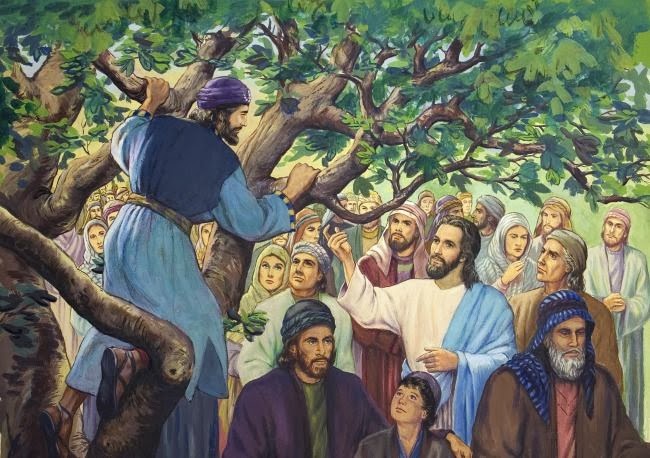
"Today salvation has come to this house.... For the Son of Man has come to seek and to save what was lost."

Lk 19:1-10


FROM MOBILE GABRIEL

* 19:1-10 The story of Zacchaeus, the tax collector, is unique to Luke's gospel. Luke uses Zacchaeus, a rich man (as said in Luke 19:2), to provide a contrast with the rich man of Luke 18:18-23. There the rich man was unable or unwilling to detach himself from his material possessions in order to become a follower of Jesus. Here Zacchaeus promises to give half of his possessions to the poor (Luke 19:8) and becomes a recipient of salvation (Luke 19:9-10). For Luke, this exemplifies the proper attitude toward wealth. Wealth in itself is not bad but it often possesses the wealthy to a greater degree than they possess it.

* 19:2 The name, Zacchaeus, means "pure" or "clean." Zacchaeus straddles two of Luke's symbolic worlds. He is the tax collector who responds generously to the call of God. He is also the rich man who liberates himself from his possessions only by great difficulty.

* 19:5 Zacchaeus' action is not at all in keeping with his dignity as either a rich man or as a chief tax collector and, in fact, expresses an extreme longing to see Jesus even if it is from an essentially hidden position. Jesus does not allow Zacchaeus to remain behind the scenes and calls out to him. Jesus then invites Himself to Zacchaeus's house. In the gospels the word, "today," often refers not only to the "today" in which the story took place, but also to the "today" in which the gospel is read. Jesus' presence causes Divine action to occur even in our today. Jesus is still inviting Himself into the lives of those who long to see Him.

* 19:6 Zacchaeus responds with joy and welcomes Jesus in contrast to the usual response given by the wealthy.

* 19:7 The crowd objects to Jesus crossing the boundaries that separate the clean from the unclean.

* 19:8 Jesus has previously responded to the objections of others to His association with "sinners" (5:27-32). Here Zacchaeus, himself, answers the objections by indicating the signs of his repentance. There is some argument as to the tense with which Zacchaeus' statements are to be translated: Some translators read the present tense (here) as futuristic in which case Zacchaeus is saying that he is no longer a sinner because he is resolved to change his ways.

Others read it as iterative or customary in which case he is not a sinner because it is his customary conduct to be generous and just. By the second interpretation, Jesus merely vindicates Zacchaeus' reputation in verse 9. The problem with the second interpretation is that it would make Jesus' presence extraneous to salvation as Zacchaeus would have already achieved it on his own. Thus the first interpretation is more in keeping with the statement of Jesus in verses 9 and 10 as well as with the rest of the gospel. By giving away half of his possessions Zacchaeus is renouncing his identity as a "rich man." The fourfold restoration was traditional in cases of flagrant theft (Exod 21:37 and 2 Sam 12:6) although Zacchaeus as a tax collector could not be legally held to it.

* 19:9 The term translated as "a descendant of Abraham" literally means, "a son of Abraham." Zacchaeus repents and manifests his change of heart by attempting to amend his former ways and thus shows himself to be a true descendant of Abraham and a true heir to the promises of God in the Old Testament. This use of the depiction of Zacchaeus as a descendant of Abraham, the father of the Jews (Luke 1:73; 16:22-31), is based upon Luke's recognition of the central place occupied by Israel in the plan of salvation. Jesus presence has allowed a "rich man to pass through the eye of a needle (18:25)."

* 19:10 This verse sums up Luke's depiction of the role of Jesus as savior in this gospel. Jesus came to "seek out and to save the lost."

Tuesday, October 22, 2013

30TH SUNDAY IN ORDINARY TIME (C)


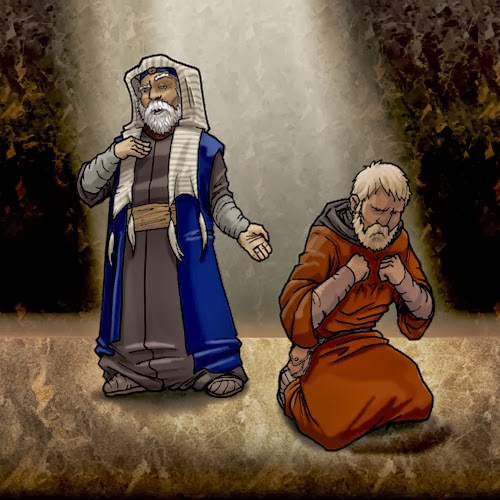
I tell you, the latter (tax collector) went home justified, not the former (pharisee); for everyone who exalts himself will be humbled, and the one who humbles himself will be exalted.
Lk 18:9-14

Click to go to << 30th Sunday in Ordinary Time 2010 >>
Click to go to << 30th Sunday in Ordinary Time 2007 >>

Wednesday, October 16, 2013

29TH SUNDAY IN ORDINARY TIME (C)


While it is true that I neither fear God nor respect any human being, because this widow keeps bothering me I shall deliver a just decision for her lest she finally come and strike me.'" 

Lk 18:1-8

Click to go to << 29th Sunday in Ordinary Time (C) 2010 >>
Click to go to << 29th Sunday in Ordinary Time (C) 2007 >>

Tuesday, October 08, 2013

28TH SUNDAY IN ORDINARY TIME (C)


Jesus, Master! Have pity on us!
Lk 17:11-19 dd

Click to go to << 28th Sunday in Ordinary Time 2010 >>
Click to go to << 28th Sunday in Ordinary Time 2007 >>