Saturday, November 15, 2008

33rd SUNDAY IN ORDINARY TIME (A)

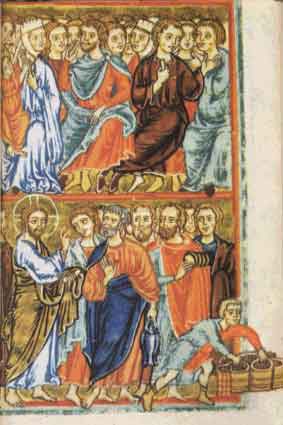
A man going on a journey called in his servants and entrusted his possessions to them.
Mt 25:14-30


EXPLANATION OF THE GOSPEL

This parable is connected with the Last Judgment (Mt 6:31ff). What is the reason behind this choice? We are approaching the end of the Liturgical Year. And with the end of the Liturgical Year also comes Advent. The theme at this time of the liturgical year is the Parousia, the second coming of Christ. The Last Judgment takes place at the Parousia.

A man going on a journey called in his servants and entrusted his possessions to them. To one he gave five talents; to another, two; to a third, one--to each according to his ability.

Talent here refers to a unit of money. Five talents would be about $6,600.00.

According to his ability. God is reasonable. He is considerate. He expects from us only what we are capable of. Even in terms of life’s challenges, God will not lead us where his grace can not keep us. In other words, God will not try us beyond our strength.

But the man who received one went off and dug a hole in the ground and buried his master's money.

Burying in the ground was a way of securing valuables. Remember the Parable of the Buried Treasure? Especially in times of war, people buried their money and then escaped to safety. When the danger was over, they would return and dig up their money. Unfortunately, someone else might find it ahead of the owner. Or it can also happen that the owner dies and so the money lay buried until someone else finds it.

For to everyone who has, more will be given and he will grow rich; but from the one who has not, even what he has will be taken away.

If you cooperate with the grace of God, you will progress in your spiritual life. In the field of business, the one with more money is able to grow his business because he has more capital. With the growth in business, more money comes in.

But if you don’t cooperate, then you will certainly regress. It’s like the palo sebo. If you don’t keep on climbing, the grease on the bamboo pole will certainly make you slide down. If you don’t progress, you’ll regress.

And throw this useless servant into the darkness outside, where there will be wailing and grinding of teeth.

In the bible this is how the evil doers react when they see the just rewarded. Wailing and grinding of teeth expresses anger and sadness.

MAKING SOMETHING OUT OF YOUR LIFE

We are expected to do something with our lives. Another way of putting it would be: “Your life is God’s gift to you. What you do with your life is your gift to God.” In the same vein St. Iraeneus wrote: “The glory of God is a man fully alive.”

At the Last Judgment we would be asked: “What have you done with your life?”

But to be able to make something worthwhile with our lives, we need to get out of our comfort zone. We need to take risks. We need to overcome our fears. Some of our fears are:
- I might fail. Fear of failure.
- It’s too difficult. Fear of paying the price, that is, fear of working hard and making sacrifices.

At the time of Columbus, people thought that the earth was flat. If you took a boat and sailed far enough, your boat would fall off the earth. Columbus did not remain his comfort zone. He did not allow the fears of his contemporaries to pre-vent him from exploring the unknown. And because he left his comfort zone, he discovered the New World.

Many Filipinos leave their country and venture into strange lands in order to give their children a better future. To do that they had to abandon their comfort zone and face the unknown. Our word for that is ‘makipagsapalaran’, which mean taking your chances.

One of the reasons why we are unable to leave our comfort zone is because we are paralyzed by fear of failure. "I might fail because I might not be good enough to face the challenges I will meet out there." But precisely by leaving our comfort zone and taking our chances, we are forced to look at our inner resources in order to meet the challenges out there.

They say if you want to go into business, you must be strong. I know of a teacher who loved teaching. But with her children growing up, she realized she needed more money if she were to be able to send her children to top schools. The only practical option for her was to leave teaching. But teaching was what all she knew. But one day she finally decided to hand in her resignation papers. Then she ventured into business. It was only then that she realized that she had talent for business. And she did well. And she was able to send all her four children to the top universities.

Unless we leave our comfort zone, we will not be able to discover our strengths and yes, even our weaknesses. Unless we leave our comfort zone, we will not be able to achieve something better, something greater.

Our life is God’s gift to us. What we do with our lives is our gift to God. Let’s give great gifts to God.

Saturday, November 08, 2008

DEDICATION OF THE BASILICA OF ST. JOHN LATERAN

Destroy this temple and in three days I will raise it up.
Jn 2:13-22


EXPLANATION OF THE GOSPEL

Since the Passover of the Jews was near, Jesus went up to Jerusalem.

According to the gospel of John, this was the first of the three Passovers of Jesus in Jerusalem. This is consistent with tradition which states that the ministry of Jesus spanned three years.

He found in the temple area those who sold oxen, sheep, and doves, as well as the money-changers seated there.

These animals were bought by the pilgrims and offered as sacrifice in the temple.

The presence of money changers is not surprising. First of all, the Passover attracted Jewish pilgrims from the diaspora, that is, Jews living outside the Holy Land. Secondly, the money that they brought (even those living in the Holy Land) had the image of the emperor. The Jewish religion forbade the use of images. For this reason these coins can not be used in the Temple. The money changers were there to change these coins with the “Temple” coins.

Stop making my Father’s house a marketplace.

Jesus is the only begotten Son of the Father.

His disciples recalled the words of Scripture, “Zeal for your house….” Therefore, when he was raised from the dead, his disciples remembered that he had said this.

Recall and remember is not just about memory. In John’s gospel, it has a special meaning. It is the process of becoming aware that in a particular event Jesus fulfilled the Scriptures.

In the gospels of Matthew, Mark and Luke, the cleansing of the Temple occurred at the end of Jesus’ ministry and was the immediate cause of his death. In John’s gospel, it took place at the beginning of his ministry. And it was in the context of Jesus talking about true worshipers. Also, it was the raising of Lazarus from the dead that was the immediate cause of his death in John’s gospel.

“Zeal for your house….” is a quote from Psalm 69. This psalm is called a Messianic psalm. In other words, John by using this psalm is saying that Jesus is the promised Messiah.

“What sign can you show us for doing this?”

John never uses the word ‘miracle’. Instead, he uses the word ‘sign’. In other words, the Jews were asking Jesus to work a miracle in order to show that he had the authority to act the way he did (cleansing of the Temple).

But he was speaking about the temple of his Body.

This illustrates a technique of John’s gospel. Jesus’ words would be misunderstood and this gives the gospel an opportunity to develop and explain further its message.

Other examples where this literary device is used are the conversation between Jesus and Nicodemus (being born from above and not being born again) and that between Jesus and the Samaritan woman (Jesus giving the Holy Spirit and not flowing water).

And they came to believe the Scripture and the word Jesus had spoken.

This statement seems to put the word Scriptures and the word of Jesus on the same level. This is, of course, correct because Jesus is the Word of God. He is God.


THE BASILICA

From Wikipedia

The Basilica of St John Lateran — in Italian, the Basilica di San Giovanni in Laterano — is the CATHEDRAL CHURCH OF ROME AND THE OFFICIAL ECCLESIASTICAL SEAT OF THE BISHOP OF ROME, WHO IS THE POPE. Officially named Archibasilica Sanctissimi Salvatoris ("Archbasilica of the Most Holy Saviour"), it is the oldest and ranks first (being the cathedral of Rome) among the four major basilicas of Rome, and holds the title of ecumenical mother church (mother church of the whole inhabited world) among Roman Catholics. The current archpriest of St. John Lateran is Camillo Cardinal Ruini, Cardinal Vicar General for the Diocese of Rome.

An inscription on the façade, Christo Salvatore, dedicates the Lateran as Archbasilica of the Most Holy Saviour, for the cathedrals of all patriarchs are dedicated to Christ himself. As the cathedral of the Bishop of Rome, containing the papal throne (Cathedra Romana), it ranks above all other churches in the Roman Catholic Church, even above St. Peter's Basilica in the Vatican.


THE FEAST

From Mobile Gabriel

Every parish celebrates the anniversary of the ceremony in which its parish church was consecrated to God and dedicated to the worship of God. Today we celebrate the Feast of the Dedication of the Basilica of St. John Lateran in Rome.

Even though people around the globe associate the pope with the more famous Basilica of St. Peter, his cathedral church as Bishop of Rome is the Basilica of St. John.

This celebration started out as a purely local event but eventually November 9th came to be a celebration of the unity of the church expressed in the pope's ministry.

The church is not buildings; it is people united by the Spirit of God. Paul tells us this in the second reading. Both the Gospel and the first reading attempt to enlarge our vision of the church. Today it is appropriate to reconsider what the church really is and where God is calling each of us to fit into it. Am I listening to this call? Am I striving to avoid hearing it?

Saturday, November 01, 2008

ALL SOULS DAY

For this is the will of my Father, that everyone who sees the Son and believes in him
may have eternal life, and I shall raise him on the last day.
Jn 6:37-40


Do you believe in ghosts? Have you seen one?

When I was still in the seminary, our Rector recounted this unusual incident. He said it happened in the morning. While he was in his room, preparing to teach, he saw his friend sitting quietly on his bed. And this friend of his was already dead. He said nothing. He soon quietly disappeared. Later our Rector said that he celebrated Mass for the repose of the soul of his friend.

God is merciful. He wants all men to be saved. But we also know that we are sinners. We know we are weak. And therefore, purgatory is a real possibility for us. For this reason we pray for the dead. And today Holy Mother Church invites all of us to pray not just for our beloved dead but for all the dead. Some of them might have been forgotten so that no one prays for them. At least today these forgotten souls will be remembered.

If we are able to help those who are in purgatory, it is because of the communion of saints. Every Sunday we profess our belief in the communion of saints when we recite the creed. What is the communion of saints all about? In simple terms it means that there is a next life and we do not lose our connection with those who have gone to that next life so much so that our prayers can help them leave purgatory and enter heaven.

Once I was asked to bless a house. When I asked why, they said that their mother who had just died was ‘nagpaparamdam’. And so I said to them: “Do you know what are asking me to do? You are asking me to drive your mother away. Why do you want to drive your mother away? Do you hate her?” They replied, “No.” So I said: “Next time she makes her presence felt, talk to her.”

Why are we scared of the dead? Because we watch horror movies and so we think that the dead are as scary as they are presented in those movies. But in fact, those who have seen their beloved dead say that they are not scary at all. And if you did not know they are already dead, you would think they are still alive. A classmate of mine said that when his father died, his father showed himself to a friend who still did not know that he had died. This friend greeted him warmly. It was only later in the day that he was informed that his friend had died.

If the dead show themselves or make their presence felt, it is because God allowed them to do so. It is also because of the communion of saints. We do not lose our connection with those who have died. That is why they can show themselves to us or make their presence felt.

When you lose something, to whom do we pray? St. Anthony. When someone is having a difficult pregnancy or if there is difficulty in conceving a baby, to whom do we pray? St. Dominic Savio. If we are in a hopeless situation, to whom do we pray? St. Jude.

This is another illustration of the communion of saints. It means those who are in heaven can help us. When we pray to the Saints, we are actually asking them to pray for us.

If we can pray to the Saints, we can also pray to our beloved dead. If our beloved dead are already in heaven, then they are saints (with small letter “s”). The only difference between them (saints with small “s”) and the Saints like St. Anthony (Saints with capital “S”) is that the latter were canonized or publicly recognized by the church. But once you are in heaven, being a saint with a small “s” and being a Saint with a big “S” does not really matter. Saint Anthony will not go to our beloved dead and say: “I’m superior to you because I have a big “S” while you only have a small “s”.”

On this commemoration of All Saints, let us pray FOR our beloved dead in case they need our prayers. Let us also pray TO our beloved dead in case they are already in heaven.

Saturday, October 25, 2008

30th SUNDAY OF THE YEAR (A)

"Teacher, which commandment in the law is the greatest?"
Mt 22:34-40


EXPLANATION OF THE READING

When the Pharisees heard that Jesus had silenced the Sadducees….

Previous to this encounter with the Pharisees, the Sadducees tried to confound Jesus by putting to him a hypothetical problem. A woman married a man. The man died childless. According to the Levirate law, the man’s brother had to marry the widow so that the family lie of the dead man could be continued. In the end, all seven brothers married the widow. At the resurrection, whose wife will she be? Jesus replied by saying that in the resurrection there will be no marriage.

"Teacher, which commandment in the law is the greatest?"

This seems to be genuine question for at the time of Jesus there seemed to have been a concern to systematize the Torah which consisted of 613 precepts. Hillel (a rabbi) reduced them to one: "Do not do what is hateful to you to a fellow human being" (cf. Lev. 19:18) while Simlai (another rabbi) pointed to Amos 5:4, "Seek me and live!"

"You shall love the Lord, your God, with all your heart, with all your soul, and with all your mind."

The Septuagint (Greek translation of the Old Testament) uses “with all your heart” instead of “with all you mind”. “Mind” should be understood as referring to thought or to reflection.

The second is like it.

The first and second commandments are similar not identical. They are not identical such that loving one’s neighbour means loving God and vice versa. They are similar because of their nature (both concern love) and of their equal importance (both commandments have to be kept).

An alternative translation would be: “The second is equally important”.

You shall love your neighbor as yourself.

The expression “as yourself” means that we should love our neighbour totally (with all your heart). It is not a recommendation to love ourselves first in order to be able to love our neighbour nor to love them in the same way as we love ourselves.

The originality of the response of Jesus is not in the idea of love of God and of neighbour. For these commandments are found in Lv 19:18 and Dt 6:5, but in the fact that Jesus united them and gave them equal importance and above all in the simplification and concentration of the whole law in these two commandments.

Saturday, October 18, 2008

29th SUNDAY IN ORDINARY TIME (A)

Then repay to Caesar what belongs to Caesar and to God what belongs to God.
Mt 22:15-21

EXPLANATION OF THE READING

They (Pharisees) sent their disciples to him, with the Herodians.

The Pharisees saw the occupation of the Romans as punishment from God.
The Herodians were the supporters of Herod Agrippa, tetrarch of Galilee and Perea. They favored Roman rule. The gospel of St. Luke seems to indicate that Herod was hostile to Jesus.

Teacher, we know that you are a truthful man and that you teach the way of God.

The way of God is either the way pointed out by God or the way that leads to God.

Is it lawful to pay the census tax to Caesar or not?"

There were other indirect taxes that the Jew paid such as toll fee and customs tax. The census tax is a tribute paid by all conquered countries to the Roman empire. All Jews paid the same amount. Only children and the elderly did not pay it. It was a shame to pay the tribute because it was a sign of subjugation to Rome. The zealots forbade their followers from paying the census tax.

The question was a trap. If Jesus said that it was lawful, he would lose credibility with the people because it meant that he was accepting Roman rule which the people detested. If he said it was not lawful, then the Herodians would report him to the Romans for being on the side of the zealots.

Show me the coin that pays the census tax. Then they handed him the Roman coin.

The Roman coin in question was the denarius. It was a silver coin and was the standard daily wage of a labourer.

The fact that they had the coin meant that they were using it and implied the acceptance, although unwillingly, of the advantages of Roman rule.

He said to them, "Whose image is this and whose inscription?" They replied, "Caesar's."

The inscription read "Tiberius Caesar son of the divine Augustus, great high priest."

At that he said to them, "Then repay to Caesar what belongs to Caesar and to God what belongs to God."

Jesus seems to say that those who willingly use the coin that is Caesar's should repay him in kind. The answer avoids directly taking sides in the question of the lawfulness of the tax.

Coinage in the ancient world had significant political power. Rulers issued coins with their own image and inscription on them. In a certain sense the coin was regarded as the personal property of the ruler. Where the coin was valid the ruler held political sway over the people. Since the Jews used the Roman currency, Jesus explained that what belonged to Caesar must be given to Caesar.

He also says that the listeners are to be as concerned with how to give to God the things that are God's. They should be more concerned with repaying God with the good deeds that are his due.

Saturday, October 04, 2008

27th SUNDAY IN ORDINARY TIME (A)

The kingdom of God will be taken away from you and given to a people that will produce its fruit.
Mt 21:33-43


EXPLANATION OF THE READING

There was a landowner who planted a vineyard.
The landowner is God; the vineyard, Israel.

When vintage time drew near, he sent his servants to the tenants to obtain his produce.
These were the prophets God sent to Israel.

But the tenants seized the servants and one they beat, another they killed, and a third they stoned. Again he sent other servants, more numerous than the first ones, but they treated them in the same way.
Israel would not accept the message of the Prophets.

They seized him (the son of the landowner), threw him out of the vineyard, and killed him.
Jesus was put to death outside the walls of Jerusalem, on Calvary.

He will put those wretched men to a wretched death.
In fact, the Romans destroyed Jerusalem in the year 70AD and scattered the Jews throughout the world. In fact, it was only after the Second World War when they were able to return to Palestine and re-establish themselves as a nation.

The stone that the builders rejected has become the cornerstone.
Wikipedia: The cornerstone (or foundation stone) concept is derived from the first stone set in the construction of a masonry foundation, important since all other stones will be set in reference to this stone, thus determining the position of the entire structure.

Some translations use keystone instead of cornerstone. Wikipedia: A keystone is the architectural piece at the crown of a vault or arch and marks its apex, locking the other pieces into position.

Either term underlines the importance of Jesus.

Therefore, I say to you, the kingdom of God will be taken away from you and given to a people that will produce its fruit.
Christians are now the New People of God in place of Israel.

THE POINT OF THE PARABLE

It is not enough to be baptized a Catholic. One must live as a Catholic. It is not enough to belong to the Catholic Church. One must behave as a good member of the Catholic Church.

Deeds are important. In fact, Jesus said: “Not everyone who says to me, 'Lord, Lord,' will enter the kingdom of heaven, but only the one who does the will of my Father in heaven (Mt 7:21-22).”

THE FRUITS THAT GOD MAY EXPECT FROM OFW'S

STEVE RAY'S OPEN LETTER TO THE FILIPINO CATHOLICS:

We stepped into the church and it was old and a bit dark. Mass had just begun and we sat toward the front. We didn't know what to expect here in Istanbul , Tur-key. I guess we expected it to be a sombre Mass but quiet and sombre it was not - I thought I heard angels joyously singing behind me.

The voices were rich, melodic and beautiful. What I discovered as I spun around to look did not surprise me because I had seen and heard the same thing in other churches around the world. It was not a choir of angels with feathered wings and halos but a group of delightful Filipino Catholics with smiles of delight and joy on their faces as they worshiped God and sang His praises. I had seen this many times before in Rome , in Israel ,in the United States and other countries.

Filipinos have special traits and they are beautifully expressed as I gazed at the happy throng giving thanks to God. What are the special traits which charac-terize these happy people? I will share a few that I have noticed- personal obser-vations- as I have travelled around the world, including visits to the Philippines

FIRST, there is a sense of community, of family. These Filipino Christians did not sit apart from each other in different isles. They sat together, closely. They didn't just sing quietly, mumbling, or simply mouthing the words. No, they raised their voices in harmony together as though they enjoyed the sense of unity and communion among them. They are family even if they are not related.

SECOND, they have an inner peace and joy which is rare in the world today. When most of the world's citizens are worried and fretful, I have found Filipinos to have joy and peace - a deep sense of God's love that over shadows them. They have problems too, and many in the Philippines have less material goods than oth-ers in the world, yet there is still a sense of happy trust in God and love of neighbour.

THIRD, there is a love for God and for his Son Jesus that is almost synony-mous with the word Filipino. There is also something that Filipinos are famous for around the world - their love for the Blessed Mother. Among the many Filipinos I have met, the affectionate title for Mary I always hear from their lips is "Mama Mary." For these gentle folks Mary is not just a theological idea, a historical per-son, or a statue in a church - Mary is the mother of their Lord and their mother as well, their "mama."

The Philippines is a Catholic nation-the only such nation in Asia -and this wonderful country exports missionaries around the world. They are not hired to be missionaries, not official workers of the church. No, they are workers and educa-tors, doctors, nurses and housekeepers that go to other lands and travel to the far reaches of the earth, and everywhere they go they take the joyous gospel of Jesus with them.

They make a sombre Mass joyful when they burst into song. They convict the pagan of sin as they always keep the love of Jesus and the Eucharist central in their lives.

My hope and prayer, while I am here in the Philippines sharing my conver-sion story from Baptist Protestant to Roman Catholic, is that the Filipino people will continue to keep these precious qualities. I pray that they will continue loving their families, loving the Catholic Church, reading the Bible, loving Jesus, His Mother and the Eucharist.

As many other religions and sects try to persuade them to leave the Church, may God give the wisdom to defend the Catholic faith. As the world tempts them to sin and seek only money and fame and power, may God grant them the serenity to always remember that obedience to Christ and love for God is far more impor-tant than all the riches the world can offer.

May the wonderful Filipino people continue to be a light of the Gospel to the whole world!

Wednesday, September 17, 2008

25th SUNDAY IN ORDINARY TIME (A)

When it was evening the owner of the vineyard said to his foreman, ‘Summon the laborers and give them their pay, beginning with the last and ending with the first.
Mt 20:1-16a

Rembrandt

EXPLANATION OF THE PASSAGE

“The kingdom of heaven is like a landowner who went out at dawn to hire laborers for his vineyard…. Going out about nine o’clock…. And he went out again around noon, and around three o’clock…. Going out about five o’clock….”

It was harvest time. It was necessary to gather in the grapes as soon as possible lest the weather (frost, perhaps?) destroy the harvest.

But this action of the landowner can be seen from a different perspective. Work was on a daily basis. And for some, no work meant no pay. And no pay meant no food. Therefore, for the landowner to go out throughout the day to hire laborers can also be seen as an act of kindness. He wanted the family of those men not go hungry.

After agreeing with them for the usual daily wage, he sent them into his vineyard.

The daily wage was a denarius. According to Wikipedia: “The Roman cur-rency system included the denarius (plural: denarii) after 211 BC, a small silver coin, and it was the most common coin produced for circulation but was slowly debased until its replacement by the antoninianus.”

And on receiving it they (those who worked the whole day) grumbled against the landowner, saying, ‘These last ones worked only one hour, and you have made them equal to us, who bore the day’s burden and the heat.’

It is understandable that those who worked the whole day would feel bad see-ing that those who worked for only an hour also were paid one denarius.

But it is also true that the owner was not being unfair to them because one de-narius was the salary for a day’s work. Furthermore it is also true that the money was his and therefore, if he wanted to give a denarius also to those worked less hours, he was perfectly free to do so.

EXPLANATION OF THE PARABLE

The parables of Jesus were meant to challenge the behaviour and beliefs of his hearers. This parable was probably addressed to the Pharisees. Jesus wanted to teach them that God’s goodness can not be reduced to mere human retribution, understood as payment that is owed, without however, reducing it to arbitrariness and setting aside of justice. He is inviting the Pharisees not to become envious in face of God’s liberality.

A REFLECTION ON WORK

After Adam’s fall, work became a curse and a punishment. “To the man he said: "Because you listened to your wife and ate from the tree of which I had for-bidden you to eat, "Cursed be the ground because of you! In toil shall you eat its yield all the days of your life.Thorns and thistles shall it bring forth to you, as you eat of the plants of the field. By the sweat of your face shall you get bread to eat, Until you return to the ground, from which you were taken; For you are dirt, and to dirt you shall return. (Gen 3:17-19)"

But through the incarnation, that is, by taking upon himself everything that is human, Jesus redeemed and sanctified all that is human, including work. Jesus, in fact, was a carpenter’s son. He must have worked with his hands.

St. John Bosco taught the spirituality of daily life. He used to say: “Do your ordinary duties extraordinarily well.” Work is part of one’s daily life. It belongs to the category of one’s ordinary duties. And one’s ordinary duties are a concrete expression of God’s will. Doing one’s work to the best of one’s ability is doing God’s will to the best of one’s ability.

Moreover, the spirituality of daily life can be seen as a way of putting into practice St. Paul’s counsel: “And whatever you do, in word or in deed, do every-thing in the name of the Lord Jesus, giving thanks to God the Father through him (Col 3:17).”

In Pilipino, a job or work is called “hanapbuhay”, literally, seek-life. Through one’s work one seek to sustain one’s life. Through your work, you are able to pro-vide food, clothing and shelter for yourself and for your family. Christian ethics require the Christian to work to support himself. St. Paul says: “In fact, when we were with you, we instructed you that if anyone was unwilling to work, neither should that one eat (2Thess 3:10).”

But work should not just be “hanapbuhay”. It should also be “nagbibigaybuhay”, that is, life-giving. Consequently, if you are not happy with your work, ei-ther change your attitude towards your work or change your work.

Your work must also provide you with opportunities for personal and profes-sional growth. If you do not find personal and professional growth in your work, it is time to work elsewhere. St. Irenaus was a bishop of Lyons in what is now France. He wrote: “The glory of God is man fully alive.” If you find personal and professional growth in your work, would you find yourself fully alive?

Finally, work is not just about practicing one’s profession. Work is also about one’s vocation. Work is not just about earning a living or actualizing one’s poten-tials. Work is also about doing something for others. Through one’s work, one can make a contribution to humanity. Through your work you are giving yourself to a cause greater than yourself.

A teacher teaches not only to earn a living. A teacher teaches not only to practice a profession. A teacher teaches in order to shape the hearts and minds of the young, whom Rizal called the hope of the Fatherland. This is the teacher’s contribution to humanity. It is a work whose fruits go beyond the boundaries of the space and time in which he lives.

Saturday, September 13, 2008

EXALTATION OF THE CROSS

For God so loved the world that he gave his only Son, so that everyone who believes in him might not perish but might have eternal life.
Jn 3:13-17


For some it has become a fashion accessory (an earring or a necklace). The cross then becomes meaningless. Instead it should become a silent proclamation of faith. It was said that when King Ferdinand III re-conquered Cordoba from the Muslims, he ordered that at the entrance to the city, the Cross should precede the royal banner. When I was young, I would often see our neighbour make the sign of the cross whenever she leaves the house. It was as if she was entrusting herself to God to keep her safe. That is a sign of faith. When I ride the jeepney, I would sometimes see a passenger make the sign of the cross upon passing a church. That is a sign of faith.

The cross has been a subject of art. At the Plaza Santa Cruz in Sevilla, Spain, we find a fine iron filigree cross. It was crafted by an expert iron smith as a reminder that a church once stood there but now is no more because Napoleon’s army destroyed it. Salvador Dali has painted a unique crucified Christ. He is suspended in space and is looking down on Lake Galilee. These representations are pleasant to look at. They are beautiful to behold. Unfortunately, they tend to hide the gruesome reality of the crucifixion. Christ crucified on Calvary was a shocking sight. We may need to watch The Passion of the Christ in order to wake us up to the fact that Good Friday was all blood, gore and excruciating pain. Calvary was not a walk in the park.

What does the cross tell us? Some theologians say that the cross tells us that sin must be such a terrible thing that it can and did put the Son of God to a terrible death. Others say that the cross teaches us that the disobedience of Adam was set right by the obedience of Jesus Christ. The obedience of the beloved Son cancelled out the disobedience of the first man.

In the National Shrine of Mary Help of Christians in Paranaque (Philippines), you will see a cross painted on the wall of the main altar. But instead of a crucified Christ, we will see a glorious risen Christ. This representation reminds us that calvary was not the end of the story. The story of Jesus did not end with the cross. The story of Jesus ended with his resurrection and ascension. This is in keeping with John’s gospel. Whenever he speaks of the glorification of Jesus, it was about his suffering, death, resurrection and ascension.

What has this got to do with us?

1. We are asked to take up our cross daily and follow Jesus. But that is not the entire Christian life. There is also the resurrection and the ascension. Yes, there must be sacrifice. But there is also joy and celebration in the Christian life.

2. All’s well that ends well. The story of Jesus ended with his resurrection and ascension. It’s comparable to the ending of fairy tales-and they lived happily ever after. That is also the ending of the Christian life. Heaven waits for us.

3. After Good Friday comes Easter Sunday. After night comes day. After the storm comes the sun. Suffering and problems are a part of life. Whether you are a believer or an unbeliever, you will have your share of life’s troubles. But you must hold on. You must not give up. You must keep faith. For this too will pass.

Sunday, August 24, 2008

21st SUNDAY IN ORDINARY TIME (A)

And so I say to you, you are Peter, and upon this rock I will build my church.
Mt 16:13-20


Simon Peter said in reply, “You are the Christ, the Son of the living God.” And so I say to you, you are Peter, and upon this rock I will build my church...."

Our faith rests on the faith that has come down to us from the apostles. That faith is secure and certain (rock).

Apostolicity is one of the signs of the true Church. We trace our origin to Jesus and his apostles. It is worth noting that the books were accepted into the New Testament because of the apostolic authority behind those books.

I will give you the keys to the kingdom of heaven.

Peter has authority in the Church. This authority comes from above, not from below. That is, the origin is from God, not from the church members. He is not like a President of a country whose mandate comes from the citizens who elected him.

The keys are seen in the Vatican flag and in most sculptures and paintings portraying Peter .

Then he strictly ordered his disciples to tell no one that he was the Christ.

The people thought that the Messiah was a political Messiah who, like David and Solomon, will restore the glory of the Kingdom of Israel and drive out the time the Romans who were ruling over Palestine. But Jesus was not this kind of Messiah and so he did not want his mission to be confused with what the common people thought.

“Who do people say that the Son of Man is? But who do you say that I am?”

The conclusion of the story of the Woman at the Well in the gospel of John is worth recalling. "We no longer believe because of your word; for we have heard for ourselves, and we know that this is truly the savior of the world."

We know many things about God and about Jesus. These were taught to us or we´ve read about them. But there comes a time when Jesus confronts us with this personal question: "Who do you say that I am?"

He doesn´t expect us to look for the answers from books we´ve read or sermon´s we´ve heard. But from our experience. "What can you say about me from experience?"

Spiritual writers say that sometimes God makes himself known to a person in a direct way, through a special spiritual experience. This is probably the way St. Paul got to know Jesus Christ.

More often than not we get to know God by means of life experiences. (A word of caution, though. Negative life experiences do have a way of negatively affecting our way of seeing God.) St. John Bosco as a child learned from his mother´s lips that God was good. But he also learned it in the midst of life´s adversities. There was a time that they had to go through a terrible famine. People died eating grass in the fields. But they survived that famine. Mama Margaret (his mother) would encourage the family to have faith in God (by then she was a widow).

Books are good. Homilies and conferences are good. But there´s nothing better than getting to know God through one´s life.

Tuesday, August 12, 2008

20th SUNDAY IN ORDINARY TIME (A)

“O woman, great is your faith! Let it be done for you as you wish.”
Mt 15:21-28


Since I am away from my homebase till mid-September, God´s Word on a Sunday Morning might not come out regularly.

At that time, Jesus withdrew to the region of Tyre and Sidon.

Tyre; usually Tyre and Sidon in the N.T. A seaport and commercial cernter on the east coast of the Mediterannean Sea (in general history known as a Phoenician city). In O.T. times it was a city-state with its own king. From Tyre, ships went all over the Mediterranean world to trade and to establish colonies. One of the chief products of Tyre was a dye known as Tyrian purple, made from shellfish.

Sidon. A city on the eastern shores of the Mediterranean Sea, about twenty-five miles north of Tyre, with which it is often named in both the O.T. and the N.T. Sidon was an old city before the time of the Israelites. LikeTyre, it was a commercial city and port for fleet of trading ships that went to all parts of the world of that time. It reached the height of its prosperity about the time of Solomon. Today the city is called. Saida.

Young People's Bible Dictionary
by Barbara Smith (Philadelphia: Westminster, 1965)

And behold, a Canaanite woman of that district came and called out, "Have pity on me, Lord, Son of David!

The Canaanite woman was a gentile or pagan. By addressing Jesus as Son of David, she was actually publicly recognizing Jesus as the messiah promised in the Old Testament.

My daughter is tormented by a demon.

In those days various illnesses were attributed to demonic activity.

But Jesus did not say a word in answer to her.

Jesus did not want to have anything to do with her because he “was sent only to the lost sheep of the house of Israel.” This was the same rule that Jesus gave to the twelve when he sent them out to proclaim the good news: "Do not go into pagan territory or enter a Samaritan town. Go rather to the lost sheep of the house of Israel."

But, as we shall see, Jesus did finally grant her request because of her faith. It was also on account of his faith that Jesus granted the centurion´s request on behalf of his servant.

“Send her away, for she keeps calling out after us.”

The woman wouldn´t take no for an answer. She was persistent. And her persistence is not only that she believed Jesus could heal but that he would heal her daughter. Her persistence reminds us of two parables of Jesus: the parable of the widow and the unjust judge and the parable of the persistent friend.

The parable of the widow and the unjust judge ends this way: "Will not God then secure the rights of his chosen ones who call out to him day and night? Will he be slow to answer them?"

On the other hand, the parable of the persistent friend ends with this teaching of Jesus: "I tell you, if he does not get up to give him the loaves because of their friendship, he will get up to give him whatever he needs because of his persistence. And I tell you, ask and you will receive; seek and you will find; knock and the door will be opened to you. For everyone who asks, receives; and the one who seeks, finds; and to the one who knocks, the door will be opened."

“It is not right to take the food of the children and throw it to the dogs.”

Jews despised gentiles and called them dogs and pigs.

She said, “Please, Lord, for even the dogs eat the scraps that fall from the table of their masters.”

The seeming insult of Jesus did not discourage the woman. On the contrary she used it to her advantage by responding the way she did.

Jesus responded by recognizing her great faith. What did she believe? I think this was what she believed in: "Yes, the people of Israel might be the chosen people. But God does not love only them. We, too, are loved by God. We, too, receive blessings from him."

Monday, August 04, 2008

19th SUNDAY IN ORDINARY TIME (A)

But when Peter saw how strong the wind was he became frightened; and, beginning to sink, he cried out, “Lord, save me!”
Mt 14:22-33


Sunday reflections will be irregular till sometime mid-September as I am away from my home base.

After doing so, he (Jesus) went up on the mountain by himself to pray. When it was evening he was there alone.

We can pray anywhere because God is everywhere. We can pray anytime because God is always present to us. Yet there are some occasions when we need to find a time and a place where we can meet God in a more intense and intimate manner. For Jesus he had to be alone and it had to be either in the evening or early in morning. A college student I knew woke up earlier than everyone else in the house so that he could pray.

Meanwhile the boat, already a few miles offshore, was being tossed about by the waves, for the wind was against it.

Rowing the boat against the waves and the wind. This is the image that comes to my mind of someone who feels that everything seems to be against him. St. John Bosco felt called to the priesthood as a young boy. At the time it seemed an impossible dream. The odds were stacked against him. Not only was his stepbrother against his getting an education. He also belonged to a poor peasant family.

During the fourth watch of the night, he (Jesus) came toward them walking on the sea.... At once Jesus spoke to them, “Take courage, it is I; do not be afraid.”

Panday was a metalsmith whose name was Flavio. One night, a meteor (bulalakaw) fell from the sky. He used the metal from the meteor to fashion a dagger and a churchbell. The dagger would magically grow to become a sword when he raised it up and pointed it to the sky. He used this to battle the Sombra Oscura, the minions of evil, who repeatedly beset the town, eventually slaying their leader, Lizardo, the "Son of the Devil".

Superheroes like Panday come to the rescue of those who are in danger. That´s why they are so popular and well-loved. And that´s why movies of superheroes are box-office hits. But they are fiction.

Jesus is not fiction. He is not a superhero. He is savior. He does not only save us from our sins. He also comes to our aid. It is well to keep in mind the reassuring words of Jesus, "Take courage. It is I. Do not be afraid."

Bravery does not mean knowing no fear. It means not allowing oneself to be mastered by fear. It is the presence of Jesus that enables us to act in spite of the fear that we feel.

An OFW I got to know in Italy said that her first stint as an OFW was in Saudi Arabia. She said that when she left the Philippines for the first time she felt fear. But she placed herself in God´s hands.

When fear threatens to overpower us, let us remember the words of Jesus, "Take courage. It is I. Do not be afraid."

But when he (Peter) saw how strong the wind was he became frightened; and, beginning to sink, he cried out, “Lord, save me!”

I have an acquaintance who is afraid of heights. He joined a hike to Mt. Batulao. At a certain portion of the hike, they had to make a steep climb. He admitted that he was afraid of heights. So he was told not to look down but to look up as he made the climb. He did as he was told and was rewarded with a marvelous view on top of the mountain.

Someone observed that Peter got frightened because instead of keeping his eyes fixed on Jesus he turned his gaze on the waves.

Sometimes the going gets tough. Sometimes people and events come that instills fear in us. Keep you eyes fixed on Jesus. Keep Jesus in mind. And when fear takes hold of us, let us cry out as Peter cried out, "Lord, save me!"

Thursday, July 31, 2008

18th SUNDAY IN ORDINARY TIME (A)

Taking the five loaves and the two fish, and looking up to heaven...
Mt 14:13-21


When Jesus heard of the death of John the Baptist, he withdrew in a boat to a deserted place by himself.

John the Baptist was beheaded on orders of King Herod. Did Jesus withdraw to keep himself safe from King Herod? His time had not yet come and therefore, he had to be careful.

But it was also possible that the reasons for going to a deserted place were (1) to pray and (2) to teach his disciples.

The crowds heard of this and followed him on foot from their towns.

To follow Jesus to an out-of-the way place was an inconvenient thing to do. Why did such a huge crowd go through the trouble? Jesus taught in a way that touched his hearers. The crowds wanted to hear Jesus. But Jesus was also known as a wonder-worker. Maybe they wanted to see him work miracles or perhaps they themselves wanted to be cured.

Matthew probably had something else in mind when he related that the crowds followed Jesus to a deserted place. He might be thinking of the Exodus when the Hebrews left Egypt and journeyed through the desert. And this was purposeful on the part of Matthew because he was setting the stage for the miracle of the multiplication of the bread as a repetition of the miracle of the manna at the time of the Exodus.

The miracle of the multiplication of the bread is the only miracle that all four evangelists relate. This miracle must, therefore, be important. Not the miracle itself but the meaning of the miracle. As we shall see, the miracle points to the gift of the Eucharist.

“Five loaves and two fish are all we have here.”

An indication that the concern of Matthew was the Eucharist was the fact that having said that there were five loaves and two fish, only the loaves continue to be mentioned. At the end of the story nothing is said about fish left-overs.

Taking the five loaves and the two fish, and looking up to heaven, he said the blessing, broke the loaves, and gave them to the disciples.

Another indication of the Eucharistic allusion are the verbs used to relate the multiplication of the bread: Taking, looking up to heaven, said the blessing, broke and gave. These are the same verbs one finds in the words of consecration in the Roman Canon (Eucharistic Prayer I).

They picked up the fragments left over—twelve wicker baskets full.

The detail of twelve wicker baskets is no accident. They allude to the twelve tribes of Israel, another indication of Matthew´s intent to point to the Exodus and the gift of manna in the desert. The relationship between the Eucharist and the Exodus-manna is developed in John 6.

The greek word used for the left-over bread is ´klasmata´, a greek word which was used to refer to the Eucharistic bread in the early church. Another indication of the Eucharistic intent of the miracle.

Those who ate were about five thousand men, not counting women and children.

According to a commentator, there must have been somewhere between 20,000 and 30,000 persons whom Jesus fed. This gives us the impression of an abundance of food, so abundant that there were twelve baskets full of left-over bread.

What we have here is an image of a banquet (eating) where food is abundant. This image is precisely the image of the messianic banquet. In other words, Matthew is pointing to Jesus as the Messiah. This did not escape the notice of the crowd in John 6. In fact they wanted to declare Jesus as king, even by force--which prompted Jesus to escape.

...and gave them to the disciples, who in turn gave them to the crowds.

One last detail. Jesus did not distribute the bread to the crowds. It was the disciples who did this. From the practical point of view, this was the best thing to do. But Matthew goes beyond the practical level. He wants to drive home a point--the intermediary role of the disciples in the church.

Monday, July 21, 2008

17th SUNDAY IN ORDINARY TIME (A)

The kingdom of heaven is like a merchant searching for fine pearls.
Mt 13:44-52


There are three parables about the reign of God in this Sunday's gospel.

* The parable of the buried treasure
* The parable of the pearl
* The parable of the net

The parables of the buried treasure and the pearl challenge the hearers of Jesus to accept God's reign even at the cost of giving up certain things in life because of its surpassing value. This giving up (sacrifice) is done with joy precisely because God's reign is worth it.

The parable of the net is similar to the parable of the wheat and the weeds. It poses two challenges. The first challenge is directed at a particular belief about the reign of God. Some christians believe that church members should all have achieved holiness. That sinners have no place there. But Jesus realistically asserts that not all who accept God's reign has achieved holiness. Some are still struggling. Some are still on the way. These have a place in God's reign.

The second challenge is directed at members of the Christian community who are not taking to heart the commitment of metanoia (change of heart leading to a change in life). God wants all men to be saved. But there is also such a thing as judgment. The good will be rewarded. The unrepentant will be punished.

Friday, July 18, 2008

16th SUNDAY IN ORDINARY TIME (A)

The kingdom of heaven is like yeast.
Mt 13:24-43


There are three parables in today's gospel:

* The parable of the wheat and weeds
* The parable of the mustard seed
* The parable of the yeast

Jesus explains the meaning of the parable of the wheat and the weeds to his disciples. But parables are not explained. Moreover the details found in them are not meant to have a meaning. That is why this is not a parable. It is an allegory. It is probable that it was the early church that transformed the parable into an allegory. That is, it was the early church that gave the meaning of the details.

Parables seek to challenge the beliefs or behavior of the hearers.

The parable the wheat and weeds challenged the belief that the Christian community is composed only of holy people. In fact, both saints and sinners are found in it. And sinners are given all the time by God to repent and be converted. However, they should expect punishment should they fail to take advantage of the time given by God.

The first members of the early Church were mainly Jewish converts. It was true that the offer of the Kingdom was first given to the Chosen People. The parable of the mustard seed challenged these Jewish Christians to accept the fact that God's kingdom is open to everyone, Jews and Gentiles alike. The birds resting on the mustard shrub alludes to this. In fact, the church grew because of the gentiles coming to faith in Jesus Christ.

In the beginning the Christians were thought of as a small sect within Judaism comparable to the Pharisees, the Zealots and the Essenes. In fact, they still worshipped in the Temple. The parable of the yeast challenged not to think that they are insignificant. They have responsibility that is world-wide in scope. They are supposed to change the world. They are supposed to be a force for good.

A FORCE FOR GOOD

An acknowledged leader observed that the alumni of his school were harmless but useless. What he meant was that the alumni had the reputation of generally being honest citizens and good christians--and no more. They were useless in the sense that after so many years they didn't seem to make a mark in society. They were afraid of stepping forward and of being counted. They seem to prefer to be in the shadows. This leader says that must change.

His point was not that the alumnus must grab the limelight. He did not say that the alumnus must have his every move publicized. What he did mean was that every alumnus must understand that being a good citizen is not just about obeying the laws of the land. Being a good citizen means helping build up the society in which he lives.

Grounded in Christian values and inspired by the example of Jesus Christ, the Christian of today must become a yeast that will build up society. He must become a force for good.

Tuesday, July 15, 2008

15th SUNDAY IN ORDINARY TIME (A)

I am away and am not sure if I can regularly upload my reflections for the Sunday. By September I hope to upload my reflections more regularly.

Mt 13:1-23

Parables are stories. And because they are stories, they catch the attention of listeners. But Jesus used parables not so much because they capture the interest of his audience but because parables challenge the beliefs or behavior of his audience. For example, Jesus used the parable of the Prodigal Son to challenge the unwelcoming attitude towards sinners of the Scribes and Pharisees. Obviously, the parable of the Seed and the Sower forces us to ask ourselves what kind of soil we are.

Jesus does not explain his parables. They are not meant to be explained in the first place. Each hearer will have to unlock for himself the meaning which the parable has for him.

Why then do we find Jesus explaining the parable to his disciples? Bible scholars say that the explanation is really how the early church understood the parable and which it then put in the mouth of Jesus.

How do I understand the parable?

1. The Path

Our parents, our teachers, our priests may have led us along the path of Christian life in our youth. But as we grew older we forgot what they taught us. We took a different road.

2. The Rocky Ground

Lack of roots. It is easy to pull plants that do not have roots. It is easy to give up Christian values that have been accepted superficially. This is the case when Christian values are based merely on emotions or on conformity. After a retreat one feels good and is inspired to be good. One is on fire. But after a week everything goes back to normal (balik sa dating ugali). It is easy to be sober in an environment where people do not drink in order to get drunk. But it is a different story when one's friends drink till they get drunk.

3. Thorns

Thorns (weeds) absorb the nutrients from the soil faster than the "good" seed. Consequently, the "good plant" grows but is stunted and produces small (inferior) fruits. Sometimes we allow other concerns to grab all our attention and all our energy so that almost nothing remains for our Christian life.

I remember watching the movie, "Oh, God! 2" In that movie, God helped a struggling singer to make it big. When he became successful, he forgot God and led a loose life. His attention and energy was absorbed by his profession and his dissolute living. Little or nothing was left for God.

4. Good Soil

The seed that fell on good soil gave an incredible yield, a hundredfold, sixtyfold, thirtyfold. The proof of a good soil is the fruit. As Jesus already said, "By their fruits you shall know them." Ingrid Betancourt was rescued from the FARC rebels. She never lost her faith. How do we know? She never gave up on prayer.

If God's word has taken root in your heart, what should we see? If God has taken possession of your soul, what do we expect to observe?

Tuesday, July 01, 2008

14th SUNDAY IN ORDINARY TIME (A)

For my yoke is easy, and my burden light.
Mt 11:25-30


STRUCTURE OF GOSPEL

The first part speaks about the learned and the intelligent vis-à-vis children:
I give praise to you, Father, Lord of heaven and earth, for although you have hidden these things from the wise and the learned you have revealed them to little ones.

Then Jesus talks about his relationship with the Father:
All things have been handed over to me by my Father. No one knows the Son except the Father, and no one knows the Father except the Son.

Finally, Jesus invites those who are burdened with the difficulties of life to come to him:
Come to me, all you who labor and are burdened, and I will give you rest.

COMMENTARY OF THE GOSPEL

You have hidden these things from the wise and the learned.

This reminds us of what happened in the Book of Daniel (2:3-13). While the wise men could not interpret the dream of Nabucodonosor, the meaning of the dream was revealed to Daniel who was a mere youth.

You have revealed them to little ones.

In Matthew’s gospel, the little ones are the disciples.

All things have been handed over to me by my Father.

“All things” refer to the Kingdom of God and its secrets.

No one knows the Son except the Father, and no one knows the Father except the Son.

Here Jesus affirms in an indirect way his unique relationship with the Father.

For my yoke is easy, and my burden light.

In Judaism, the Law of God (both written and oral) is referred to as a yoke (Sir 51:26). In this context, the yoke is not thought of as heavy nor painful. In fact the yoke of the Law is spoken of as the joy of the yoke.

Jesus places his liberating interpretation of the Law in opposition to the legal-istic interpretation of Judaism. In other words, Jesus announces to men together with the renewed Law the joy of the Kingdom.

Tuesday, June 24, 2008

ST. PETER & ST. PAUL

I will give you the keys to the Kingdom of heaven.
Mt 16:13-19


COMMENTARY

“Who do people say that the Son of Man is?” They replied, “Some say John the Baptist, others Elijah, still others Jeremiah or one of the prophets.”

John was a prophet just like Elijah and Jeremiah. People considered Jesus as one of them. And they were wrong.

He said to them, “But who do you say that I am?” Simon Peter said in reply, “You are the Christ, the Son of the living God.”

Christ is the Greek form of “Anointed”. Messiah is the Hebrew form. Peter got it right. He was able to discover who Jesus really was because the Father gave him the faith (or the “eyes”) to perceive the truth about Jesus.

In the OT the title son of God was given to angels, to faithful Israelites, to Israel itself and to the Messiah. It implied a special election from God and a special mission for the chosen one. When Christians called Jesus “Son of God”, they are declaring the Jesus is Son without equal and has a mission of saving mankind without equal.

And so I say to you, you are Peter, and upon this rock I will build my Church.

Now it is the turn of Jesus to tell Simon, son of Jonah, about his new responsibility. He would be the rock upon which Jesus would build his church. That is why he is to be called “Peter” or Cephas”.

The image of the rock is significant. Jesus said that a man who puts into prac-tice his teachings is a like a man who built his house on rock. When the flood came and the wind blew, the house remained standing. So also the Church will remain firm against the attacks of the powers of hell. Of course, it is not because of Peter but because of the strength given by Jesus Christ to Peter and the Church.

This passage is a recognition of the pre-eminent position of Peter in the primi-tive Church which according to Catholic tradition passed on to his successors, the Popes.

And the gates of the netherworld shall not prevail against it.

Netherworld is Hades or in Hebrew, Sheol, the dwelling place of the dead. Jesus declares that Sheol cannot keep in death the members of his community.

I will give you the keys to the Kingdom of heaven. Whatever you bind on earth shall be bound in heaven; and whatever you loose on earth shall be loosed in heaven.

To be able to carry out his responsibility over the Church, Jesus gives author-ity over the Church to Peter. This is signified by the symbol of the keys. This is why the Vatican flag has the image of the keys. The statue of St. Peter often has Peter holding a set of keys.

The power of the keys means: (1) the power to permit or to prohibit, (2) the power to admit or exclude from the community of faith and kingdom of God, (3) the forgiveness of sins.

Friday, June 20, 2008

12th SUNDAY IN ORDINARY TIME (A)

So do not be afraid; you are worth more than many sparrows.
Mt 10:26-33


COMMENTARY

Paraphrase of the Gospel

Do not be afraid. Proclaim the Kingdom of God.

Do not allow fear of those who can only kill the body deter you from proclaiming God’s kingdom. If you have to be afraid of anyone, be afraid of God who can not only take away your life but send you to hell as well.

But you don’t have to be afraid of God because if he takes care of sparrows that are of little value, how much more will he take care of you, you who have greater value than a flock of sparrows.

Do not be afraid of publicly professing your faith in me. If you deny that you know me, I will also deny knowing you.

Explanations

Are not two sparrows sold for a small coin?

The small coin referred to is one of the smallest Roman coin used. It is called an “as”. With an as, you can buy 8 sparrows.

Yet not one of them falls to the ground without your Father’s knowledge.

There are two possible meanings. First, God is not absent when a disciple dies. A second possible meaning is: Disciples do not die for the Gospel without God permitting it. Their death is not just an incident but an event of great value.

Everyone who acknowledges me before others, I will acknowledge before my heavenly Father.

What is spoken of here is the disciple witnessing to Jesus even at cost of shedding his blood. When this happens, he is sharing in the same lot as his Master, Jesus Christ.
The witnessing is in the form of proclaiming publicly and with one’s actions that he is solidly for Jesus Christ.

But whoever denies me before others, I will deny before my heavenly Father.

We are reminded of the betrayal of Peter: As he went out to the gate, another girl saw him and said to those who were there, "This man was with Jesus the Nazorean. Again he denied it with an oath, "I do not know the man!" A little later the bystanders came over and said to Peter, "Surely you too are one of them; even your speech gives you away." At that he began to curse and to swear, "I do not know the man." And immediately a cock crowed. (Mt 26: 71-74).
But after the Resurrection, Jesus pardoned Peter.

FOR LIFE

Fear is our emotional response to a powerful threat to one’s safety.

That emotional response triggers a behavioural response: either we flee or we are paralyzed by fear.

When I was studying theology at UST, I saw a college student running away. There was fear in his eyes. Now and then he looked back to see if anyone was following him. He was fleeing from danger.

When I was still a Brother, we went to Tagkawayan, Quezon for summer camp. While hiking along rice fields that have been harvested, a snake suddenly reared its head. It was a big one. We ran away as fast as we could. We fled from danger.

A teacher once mentioned this story. During the Japanese time, people were evacuating because of the advancing Japanese soldiers. His mother said: “Let’s just stay here together and die together.” His mother was paralyzed by fear.

A boy got a girl pregnant. He could not tell his parents what happened. He was paralyzed by fear.

Sometimes there is nothing to fear. But we scare ourselves to death. One of our priests who is a therapist related this exercise they had when he was still studying. Their professor hypnotized them. Under hypnosis, their professor told them to enter the room in their imagination and discover inside what they were afraid of. Do you know what they found inside the room of their imagination? Nothing. In other words, there was really nothing to be afraid of. But why were they afraid? Because they create monsters in their imagination.

I just recently finished two examinations. One was oral, the other written. I was anxious and afraid. In my mind, I was thinking: “What if I forget the answer to the questions? What if I was asked about something I was not able to study?” In other words, before the exams I was thinking about what could go wrong. And yet during the exams, I was able to answer all the questions pretty well. What was I doing before the exams? I was scaring myself. What I should have done was to shut out those thoughts that made me afraid.

But at other times, there is really reason to be afraid. But fear is able to overcome us because our faith is weak. If our faith is strong enough, fear will not be able to overpower us. In other words, we will be able to face and overcome our fears.

When God told Abraham to leave his father and his native land to go to a faraway land, he must have felt some fear. It is natural to fear the unknown. But because he believed that God was going with him to that faraway land, he was able to overcome that fear.

We read in Psalm 27: “The LORD is my light and my salvation; whom do I fear? The LORD is my life's refuge; of whom am I afraid?

We are told that the words “Do not be afraid” can be found 365 times in the Bible, It is as if every day of the year God keeps on reminding us not to be afraid. And why should we not be afraid? Because Jesus tells us: “It is I. Do not be afraid.” Because Jesus reassures us: “And know that I am with you always till the end of the world.”

Tuesday, June 10, 2008

11th SUNDAY IN ORDINARY TIME (A)

Jesus sent out these twelve after instructing them thus...‘The kingdom of heaven is at hand.’
Mt 9:36—10:8


COMMENTARY

At the sight of the crowds, Jesus’ heart was moved with pity for them because they were troubled and abandoned, like sheep without a shepherd.

The shepherd is a favourite image in the Bible. Jesus applies to himself the image of the Good Shepherd. When the Magi inquired where the Messiah was, the chief priests quoted from the prophet: “And you, Bethlehem, land of Judah, are by no means least among the rulers of Judah; since from you shall come a ruler, who is to shepherd my people Israel”.

The image of the shepherd was also applied to the kings of Israel. In 1 Chron 11:2 we read: “Then all Israel gathered about David in Hebron, and they said: "Surely, we are of the same bone and flesh as you. Even formerly, when Saul was still the king, it was you who led Israel in all its battles. And now the LORD, your God, has said to you, 'You shall shepherd my people Israel and be ruler over them.'"

In the Church, the bishops are the primary shepherds. That is why they carry a staff.

Nevertheless, we can say that anyone who is in authority should take the attitude of a good shepherd. The good shepherd takes care of his sheep. The leader looks after the welfare of those under him. May pagmamalasakit ang pastol para sa kanyang tupa. Pagmamalasakit is not just about making sacrifices for those under his care. It is also doing difficult things for them. And one of the things that is difficult to do is correcting them in a constructive way. Those who drink to get drunk is certainly doing wrong. How do you correct in a constructive way? It’s not easy.

“The harvest is abundant but the laborers are few; so ask the master of the harvest to send out laborers for his harvest.”

Priests and religious are called to do pastoral work. There are not enough priests and religious to take care of the pastoral needs of Filipino Catholics not only in the Philippines but all over the world. We are, therefore, asked to pray for vocations. Why pray? Because to become a priest or religious is to follow the call of one’s heart. Only God can touch people’s hearts.

Can you do more? We can be more forgiving and understanding. We can be more appreciative. When you feel appreciated, you feel like going on.

Continue loving your priests. One Indian priest who studied at the East Asian Pastoral Institute said that he was impressed because he saw how Filipinos loved their priests. When a priest feels unloved, it is easy for him to be tempted to look for love somewhere else.

You can sense when something wrong is going on with your priest. Work with the elders of the community or the parish in discerning how you can help your priest. He might be going through a midlife crisis. He might be experiencing problems of the heart. His family might be going through some crisis and he is affected.

Then he summoned his twelve disciples and gave them authority over unclean spirits to drive them out and to cure every disease and every illness.

In St. John’s gospel, the miracles of Jesus are called signs. This is because his miracles are meant to convey a message. In the mind of the people in those days, the ability to perform extraordinary deeds of power meant that the apostles had the approval of God.

But there is more to miracles than that. The more important message is that Jesus is the promised Savior who has come to defeat sin and evil in the world and in each individual.

A Baptist relative once asked me: “Are you saved?” I was taken aback be-cause it is not a question we Catholics ask. But it is a good question to ask ourselves. And the answer is something worth reflecting on. The answers are: (1) Yes, Jesus saved me a long time ago. He has already paid the price of my redemp-tion. (2) But Jesus continues to save me because as long as I live there will be a continuing battle between good and evil in my heart. (3) And one day I hope to be definitely saved by Jesus when he welcomes me into his kingdom.

The names of the twelve apostles are these….

This is the first and only time that Matthew calls the twelve disciples, “apostles”. Apostle means someone who is sent. The name is appropriate because the reading ends this way, “Jesus sent out these twelve after instructing them thus, ‘Do not go into pagan territory or enter a Samaritan town….”

FOR LIFE

What do we observe about the choice of Jesus? What we know is that Peter and Andrew and James and John are fishermen. Matthew is a tax collector. Thomas doubted the resurrection of Jesus. Judas Iscariot was a thief and the betrayer of Jesus. Externally we do not see them fit for the great responsibility of being apostles. Why did Jesus choose them?

I heard this story some time ago. They said that in Angola the children used to play with rocks and crystals along the river banks. But when the Europeans came, the Angolans were surprised to see these Europeans collecting these crystals. Later they realized that they were valuable diamonds. Of course, these diamond crystals had to be sent to Europe where they were cut and polished.

In the same way I think that Jesus saw in these twelve apostles diamonds in the rough. That is, they had potential. For three years he would develop their inner qualities until they became polished diamonds, that is, men ready to undertake the responsibility of proclaiming the good news to the ends of the earth.

The first lesson I would like to point out is this: Developing the qualities or abilities of others is a noble work. And this is the work of parents, teachers and leaders.

Hellen Keller was 19 months old when she got sick of an unknown disease. It left her blind and deaf. But when she grew up, she found a great teacher, Anne Sullivan. Anne did not only help her finish college, write books and give lectures but also become a fine woman. Anne helped Hellen Keller become a valuable diamond.

If you are a parent, teacher or leader, become God’s instrument in polishing your children, you students, those under your care into valuable diamonds.

There’s one more thing.

Why is it important for you to know what your potentials are? Why is it important for you to develop your abilities and talents? Because God gave you those talents and abilities so that you may fulfill the mission he has entrusted you to do in this world.

Why is it important to carry out that mission? It is in carrying out that mission that we achieve self-fulfilment. And with self-fulfilment comes great happiness.

When a parent says: “I can die now. My children are all settled in life”, it means he or she has achieved self-fulfilment. And he or she is happy.

When a student writes a note to his priest-friend: “Thank you for being there for me when I had problems.” the priest feels self-fulfilled in his vocation. He feels great happiness.

All of us were born for a reason, for a mission. By developing our talents and abilities we shall be able to carry out that mission well. And by fulfilling our mission in life, we shall experience self-fulfilment and happiness.

Monday, June 02, 2008

10th Sunday in Ordinary Time (A)

I did not come to call the righteous but sinners.
Mt 9:9-13

Call of Matthew by Caravaggio


COMMENTARY

He saw a man named Matthew sitting at the customs post. He said to him, “Follow me.”

Previously Jesus had already called four fishermen to follow him, Peter, Andrew, James and John. Now he calls a tax collector. Is it not intriguing why Jesus did not call anyone from a more “respectable” profession? Perhaps Jesus saw through their outward appearance. He saw in them the potential for apostolic work. And it would be the work of Jesus in their three years together to develop that potential.

Is this not the work of a teacher? Is this not the mission of a parent? To bring out the best that is already in the student, that is already in their child.

In Mark’s gospel, Matthew is called Levi, son of Alphaeus. In Luke he is merely called Levi. Matthew’s name is found in the list of the apostles. But early on there has been doubt about the identification of this Matthew with Levi. There is also doubt about this Matthew being the Matthew of the first gospel.

And he got up and followed him.

Why did Matthew leave behind a very comfortable life in order to be a disciple of Jesus? Jesus had already warned those who wanted to follow him: “Foxes have dens and birds of the sky have nests, but the Son of Man has nowhere to rest his head” (Lk 9:58). Had Matthew gone mad?
We make decisions based on the values that we have. And sometimes those decisions seem foolish.

Take for instance, a janitor at the airport. He returned a bag containing a couple of thousand dollars. To him it was the natural thing to do. Yet some of his relatives who do not share the value of uprightness told him: “Are you so stupid to return that money? You could have used it for your family.”

St. Paul said to the Corinthians: “We are fools for Christ’s sake” (1Cor 4:10). Sometimes our Christian values make us do certain things which seem foolish in the eyes of the world.

While he was at table in his house, many tax collectors and sinners came and sat with Jesus and his disciples.

Why were tax collectors lumped together with sinners? In the Roman Empire the office of tax collector was given to the highest bidder who then worked as an agent of the Roman government. As long as the tax collector met his quota, he could keep whatever profit he made. It is easy to imagine how tax collector en-riched themselves by squeezing whatever they can from the people. It is no won-der that the Pharisees branded them as the worst of sinners together with thieves and prostitutes.

Birds of the same feather flock together. Is it surprising to find fellow tax collectors and sinners invited to dinner by Matthew?

Tell me who your friends are and I will tell you who you are. If you want to develop a positive outlook in life, keep the company of positive people.

Parents need to get to know the friends of their children. It is enough to have only one bad companion for your child to go wrong.

The Pharisees saw this and said to his disciples, “Why does your teacher eat with tax collectors and sinners?”

According to the teachings of the rabbis, one should not accept the invitation of a sinner. In this case what made matters worse was that Jesus was in the com-pany of not just one but many sinners. This scandalized the Pharisees.

But it was normal for Jesus to behave in ways that scandalized the religious leaders. For instance, Jesus healed on the Sabbath, something that rabbis forbade. In fact, when he healed a woman who could not stand erect for 18 years, the leader of the synagogue told the people: “There are six days in which work is to be done. Come on those days to be healed and not on the Sabbath.”

Why did Jesus behave differently? Because his beliefs are different. Regarding the Sabbath, Jesus believed that the Sabbath was made for man and not man for the Sabbath.

What does this mean for us? If we want to know why we behave in certain ways, we have to find out what are the beliefs behind those behaviors. For instance, I work here and every month I send money back to the Philippines. Some of those to whom I send money do not work. Yet every month I continue sending money. Why? What is my belief that makes me send money every month? Is my belief correct?

Here is another simple example. A third year HS student said that he doesn’t go to confession because priests are also sinners. What is his belief that makes him to not go to confession? Is that belief correct?

I did not come to call the righteous but sinners.

Joseph wanted to divorce Mary quietly but an angel appeared to him in a dream and said, “Do not be afraid to take Mary as your wife. She will bear a son and you are to name him Jesus, because he will save his people from their sins." Right from the very beginning the mission of Jesus was made clear. He came for sinners. And at the end of his life, one of the last words of Jesus was for sinners: “Father, forgive them for they do not know what they are doing.”

Jesus had a soft heart for sinners. He even sought them out as what happened to Zacchaeus. He was on a tree, curious to see who Jesus was. And what did Jesus do? He purposely stopped in front of the tree, looked up to Zacchaeus invited himself and his disciples to his house that day. Zacchaeus was no ordinary tax collector. He was the chief tax collector. And when he expressed the desire to change his ways, Jesus happily announced: “Today salvation has come to this house. For the Son of Man has come to seek and to save what was lost” (Lk 19:10).

Did Jesus come for you? If you don’t need to be saved from your sins, then Jesus did not come for you.